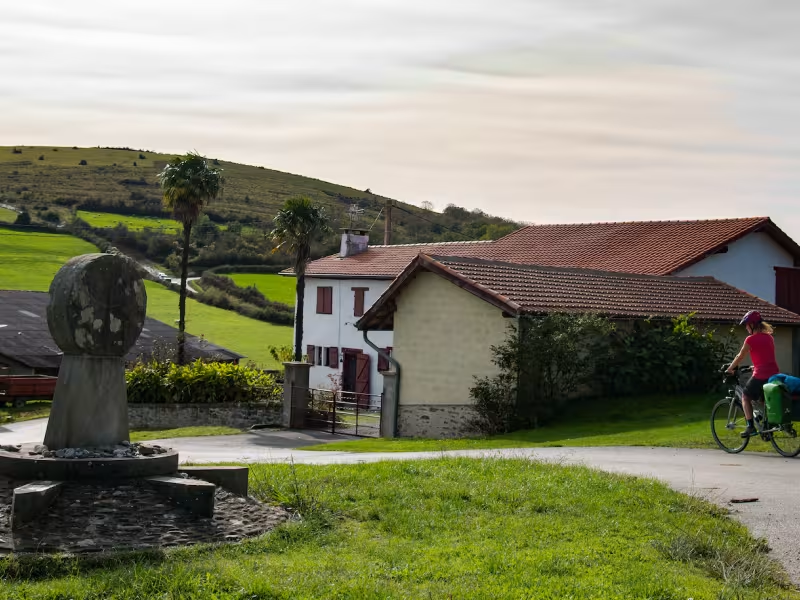
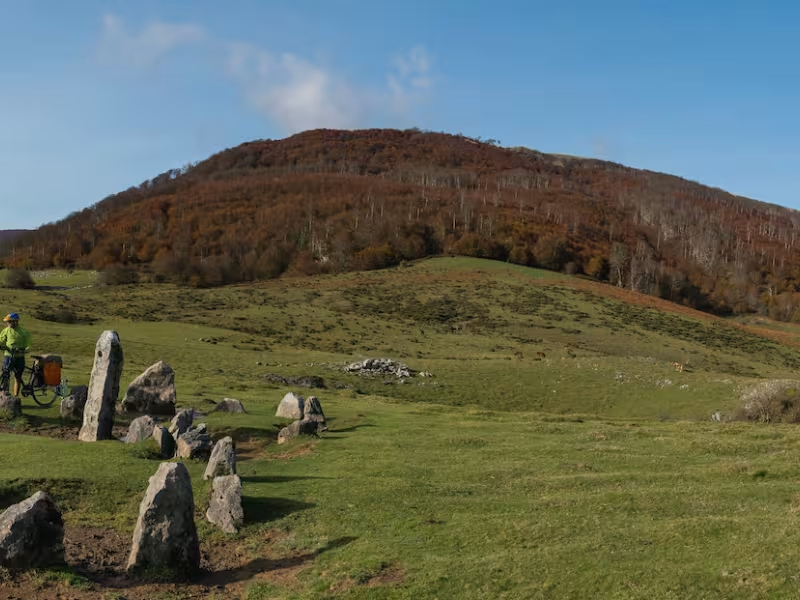
Immediately on leaving Saint-Palais, ride on to Saint-Sauveur Hill, where the Cross to Xibalterre or Gibraltar (the name for St Sauveur in the Basque language!) marks the spot where several pilgrimage routes to Santiago de Compostela (in northwest Spain) meet. All along this stage, you’ll spot many markers for this extremely popular pilgrimage, still much-loved today and rich in heritage. Both cyclists and walkers will appreciate the many related structures dotted along the climbs and descents to Saint-Jean-Pied-de-Port, not just crosses, but chapels, churches, ruined hospices and villages packed with memories, as well as countless gîtes to stop at. The number of walkers and cyclists sharing this track has been growing consistently, showing what a major European route the Scandibérique - EuroVelo 3 is. At the end of the stage, you enter Saint-Jean-Pied-de-Port via the Porte Saint-Jacques gateway; the cobbled street taking you down this way makes for a dramatic arrival!
Gradients and elevation
Slope breakdown
Road types
- Cycle path
- Routes reserved for cyclists and pedestrians (greenways, cycle tracks, towpaths), separated from cars for maximum safety.
- Shared road
- Quiet minor roads with little traffic (unless otherwise stated in the stage details). Shared with cars (stay alert).
- Not specified
- Data unavailable or being assessed. Please refer to the detailed stage description.
- Provisional
- Section on a road or cycle path awaiting better-quality facilities (see stage details).
Surface
- Smooth
- Asphalt, tarmac or smooth concrete. Optimal comfort.
- Rough
- Fine gravel, compacted stabilised surface or worn tarmac. Less comfortable, vibrations possible.
- Natural
- Dirt, grass, roots or stones. Under 5%: short sections with little impact. Higher percentage: route suited to mountain or gravel bikes only.
- Not specified
- Data unavailable or being assessed. Please refer to the detailed stage description.
The route
Along county and minor roads. Take care at the numerous points where you have to cross the RD933 road. The terrain is very undulating, with a total positive change in altitude of 450m along the stage, the maximum altitude reaching 275m. Signposted EV3.
Surfacing smooth: asphalt.
Trains
- Saint-Jean Pied de Port train station: rail link to Bayonne
Don’t miss
- Saint-Palais: the Maison des Têtes (a house bearing sculptures of noble heads); the typical streets, notably the rues de la Bidouze and du Palais de Justice; Place du Foirail, an embellished square; the church of St Mary Magdalene and its rare Cavaillé-Coll organ; the oldest, most beautiful pelota court (or trinquet) in the French Basque country and the Pierre Guéraçague pelota wall; lovely façades and gardens beside the Bidouze..
- La Stèle de Gibraltar (at kilometre 3.6): this emblematic cross stands just 100m from the route
- La Chapelle d'Harambeltz (at kilometre 8.4): a chapel 1.2km from the route
- Le Village d’Ostabat-Asme (at kilometre 12.15 km): the village lies 1km from the route
- Croix de Galtzetaburu (at kilometre 20): another famous cross
- Saint-Jean le Vieux : the village
- Saint-Jean Pied-de-Port: Porte Saint-Jacques, or St James Gateway (part of the UNESCO World Heritage Site ‘Routes of Santiago de Compostela in France’, awarded in 1998); the citadel and its Gastelumendy Redoubt; the ramparts of the upper town and the Faubourg d’Espagne; the parish church dedicated to the Virgin Mary’s Assumption; the so-called Bishops’ Prison