9 stages · 245 km

Gradients and elevation

Ascents: 1214m
Descents: 1210m
Lowest point: 0m
Highest point: 125m

Road types

219km (89%) By road
26km (11%) Cycle path

Surface

64km (197%) Smooth
1km (3%) Rough

9 stages used

Roscoff / Plouescat

1 Roscoff / Plouescat

32 km
2 h 56 min
I cycle often
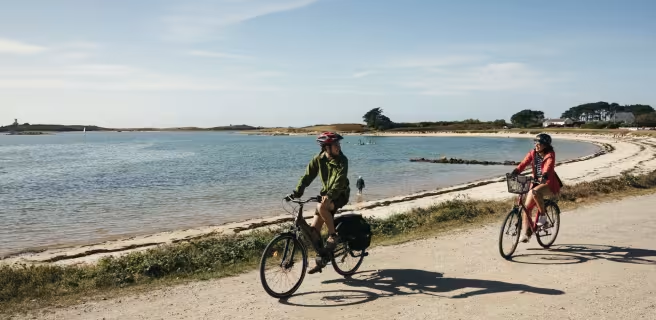
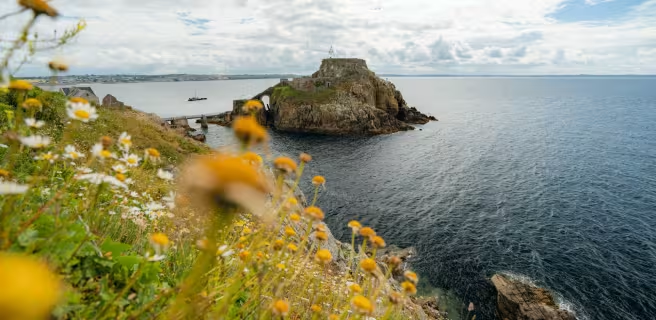
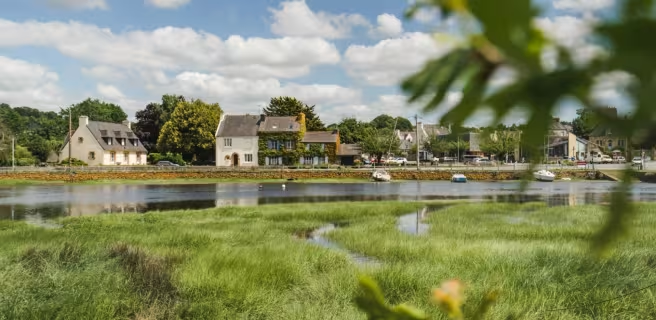
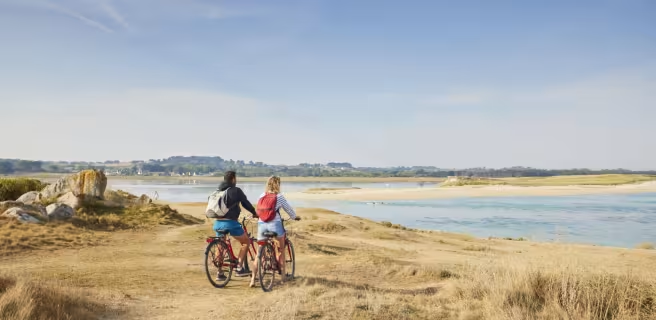
Starting from the port of Roscoff, in the département (French county) of Finistère in northwest Brittany, enjoy the coast to the full riding off westwards towards Plouescat. On this stage, breathe in the invigorating sea air; you’ll feel almost like you’re heading out onto the open seas! Our cycle route, La Littorale, reveals a whole wonderful range of viewpoints and shifting colours, with a mix of creeks, coves, scattered granite boulders, neatly tended fields and stone-built villages… In short, relish the traditional sides to Brittany from the start of this cycle route!
Plouescat / Brignogan-Plages

2 Plouescat / Brignogan-Plages

22 km
1 h 55 min
I cycle often
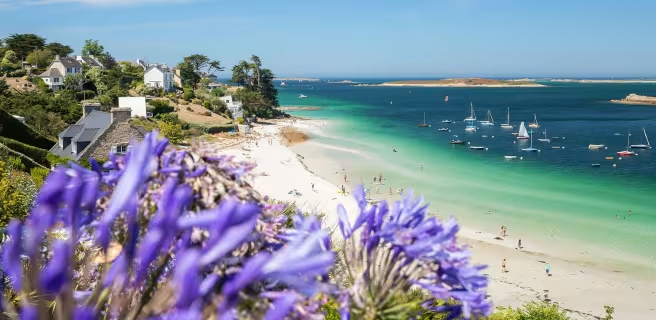
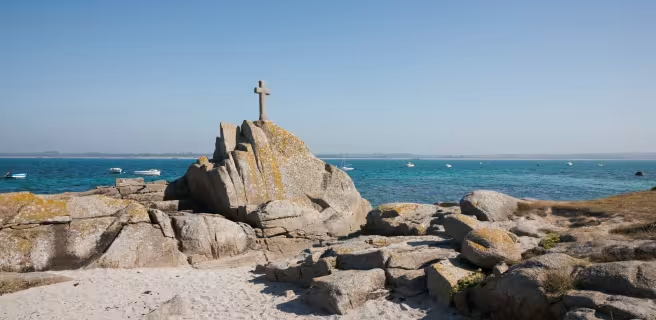
You enter a coastal area known as the Côte des Légendes as you cycle west from Plouescat and its fine sandy beaches. The imposing spire rising from Goulven Church seems to stand guard between you and the sea as you cycle by. It reaches 58m in height, dominating the Bay of Goulven, a protected natural area and a paradise for migrating birds. Riding along, the seascapes change by the minute as the tide goes in and out. Admire the views from Beg ar Groas Headland onto a remarkably preserved bay before reaching the charming resort of Brignogan.
Brignogan-Plages / Plouguerneau

3 Brignogan-Plages / Plouguerneau

42 km
4 h 02 min
I cycle often
La Littorale cycle route leads you on by bike along the Route des Phares, dotted with impressive lighthouses. The first you spot is that of Pontusval, said to be the most photographed lighthouse in France. Cycle on towards l’Île Vierge, an island boasting the tallest lighthouse in Europe. On this stretch of northern Finistère coast you in fact come to the most intense concentration of lighthouses in the world. They bear witness to the strong sea-faring history and traditions of these parts. On a different scale, the little thatched cottages in the village of Meneham hide among enormous natural blocks of granite; this enchanting place retains an air of mystery.
Plouguerneau / Landéda

4 Plouguerneau / Landéda

10 km
40 min
I cycle often
Heading west to Landéda, La Littorale cycle route leads you around the Aber Wrac’h, the biggest and most maritime of the abers (a Breton word for a deep estuary) along the north Finistère coast. The Beg-an-Toull Belvedere provides unbeatable views on this most magnificent of Breton abers. Should you wish to reduce substantially the distance to ride right around this aber, in July and August, there’s the option to take the little ferry (bac in French) linking the port of Aber Wrac’h to Perros (the name for this little port sometimes spelt Perroz). Do take in the view across the mouth of the Aber Wrac’h from the Sémaphore (an old coastal signal station turned local cultural centre), standing out in an exceptional spot, close to the well-named Notre-Dame des Anges Abbey ruins.
Landéda / Saint-Pabu

5 Landéda / Saint-Pabu

31 km
2 h 03 min
I cycle often
Once past l’Aber Wrac’h, La Littorale cycle route guides you on to explore the Aber Benoît, a deep sea inlet with richly varied landscapes. You cross this aber via the Pont de Tréglonou bridge, nestling at the back of the estuary, the looks of whose banks change greatly with the tides. Look out for bird species that thrive in this environment on the divide between fresh and salt waters, such as shelducks, egrets and wild swans. To learn more about the special natural features of the north Finistère abers, dismount to visit the Centre d’interprétation de la Maison des Abers, covering the topic in detail.
Saint-Pabu / Lanildut

6 Saint-Pabu / Lanildut

27 km
1 h 46 min
I cycle often
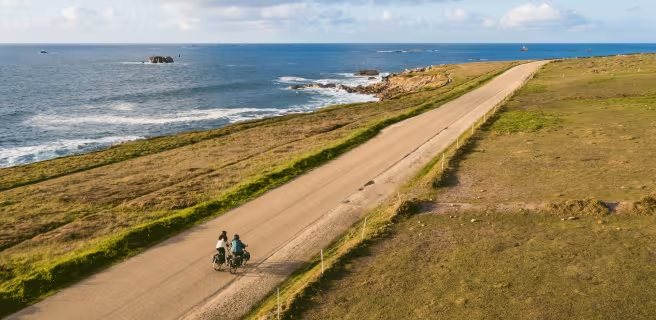
La Littorale cycle route now offers you a sobering history lesson connected to these rocky maritime parts, as you ride towards Lanildut via Portsall (in the municapility of Ploudalmézeau); here, dismount to visit the museum spaces of Ancre an eor - Dans le sillage de l’Amoco Cadiz, recalling the environmental catastrophe caused by the sinking of an oil tanker in these parts in 1978. As to the splendid Route Touristique de Landunvez, it has wonderful views down on the sea, giving cyclists the impression that they’re almost riding across the waves! The Presqu’île Saint-Laurent, a peninsula, provides one of the finest views across to an iconic lighthouse, the Phare du Four, out to sea. A last place to explore on this stage is the Maison de l’Algue, covering the topic of seaweed and its many uses in these parts, this visitor centre set beside the Aber Ildut, the smallest of the three main abers marking the north Finistère coastline.
Lanildut / Le Conquet

7 Lanildut / Le Conquet

20 km
1 h 51 min
I cycle often
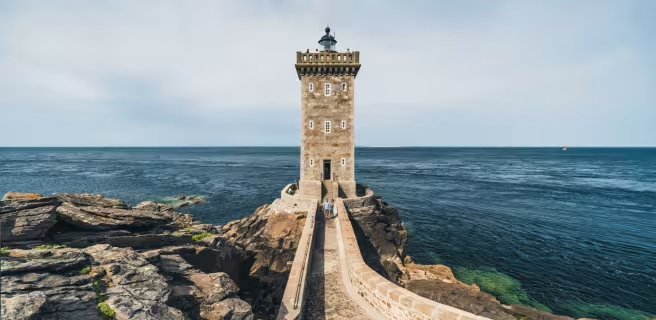
From May to October, there’s the possibility of crossing the Aber Ildut, with your bike on board an electric boat, or then make the most of the extra 14km, going all the way around the Aber, to explore the small-scale heritage beside the cycle route around Brélès (with its church and washhouses, or lavoirs). Next, you ride along close to the Pointe de Corsen, the most westerly headland on mainland France, and the theoretical dividing line between the Channel (la Manche in French) and the Atlantic Ocean. It’s really worth stopping at the Phare de Trézien, a lighthouse in the parish of Plouarzel, but this one built inland, some 500m from the coast. Continue on to the Phare de Kermorvan, the latter lighthouse standing out on the headland that bears the same name. Le Conquet, long renowned as a fishing port, operates ferries year-round to the islands of Molène and Ouessant (Ushant in English), which also feature further iconic lighthouses. Trips out to these splendid islands offer further potential exciting adventures just off La Littorale’s route.
Le Conquet / Brest

8 Le Conquet / Brest

33 km
3 h 15 min
I cycle often
You ride along the coast towards Brest via the Pointe de Saint-Mathieu (in the parish of Plougonvelin), a headland famed both for the ruins of a medieval abbey and for a lighthouse. The views from the top of the latter, taking in the reefs of Les Vieux Moines and the Chaussée des Pierres Noires, are breathtaking. Next, you ride along the side of the Anse de Bertheaume, a bay overseen by a fort designed by Vauban, Louis XIV’s great engineer. There follow some tremendous, scenic views across the Rade de Brest, one of the largest enclosed bays in the world, covering 180km2. At the Rade’s goulet, or narrow entrance from the Atlantic, the Phare du Petit Minou is a lighthouse placed there to indicate to boats the channel they need to follow to enter into the Rade de Brest, by lining it up with the Phare du Portzic, another lighthouse, which you ride close to in order to reach Brest, a sprawling city that very much lives from its strong connections with the sea.
Brest / Daoulas

9 Brest / Daoulas

28 km
1 h 51 min
I cycle often
An unmissable, unavoidable major crossing point along La Littorale cycle route is the massive Pont Albert-Louppe, the bridge spanning the place where the Elorn River flows into the Rade de Brest’s huge enclosed bay, with the Plougastel Peninsula on the other, southern side. The Plougastel area is renowned for its strawberry production. To understand the local heritage, stop at the Musée de la Fraise et du Patrimoine. Continue on to the historic town of Daoulas, still marked by the maritime influence of the Rade de Brest. It makes a fine stop, with its remarkable abbey now home to a cultural centre that stages major exhibitions, plus it features gardens with plants and trees from around the world that boast medicinal properties.
Afficher les étapes