
Lanildut / Le Conquet
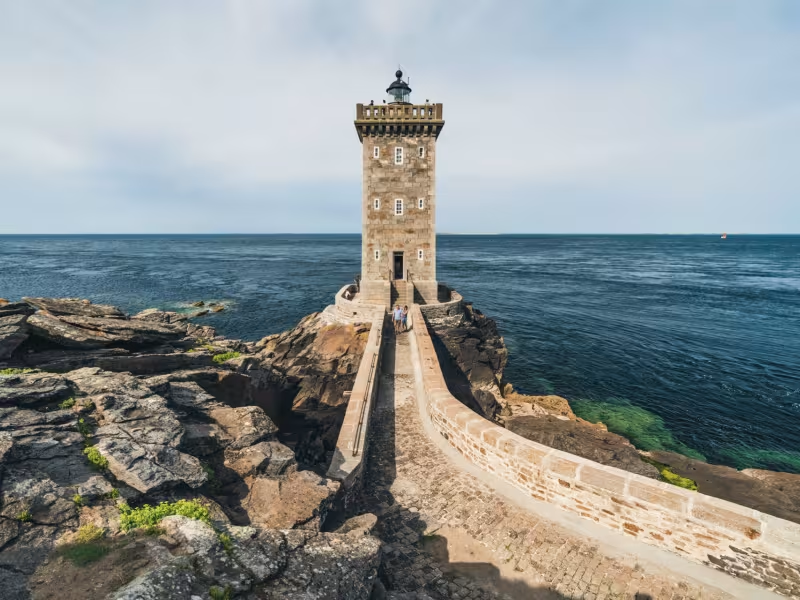
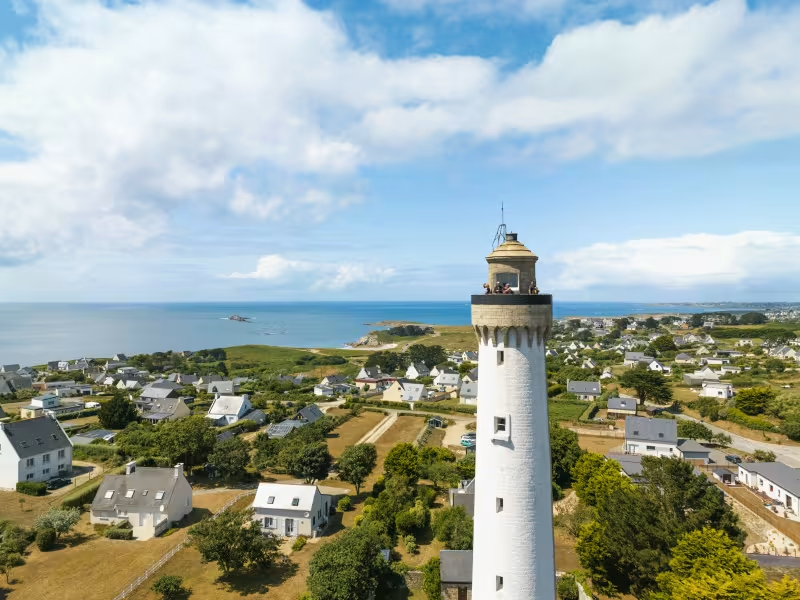
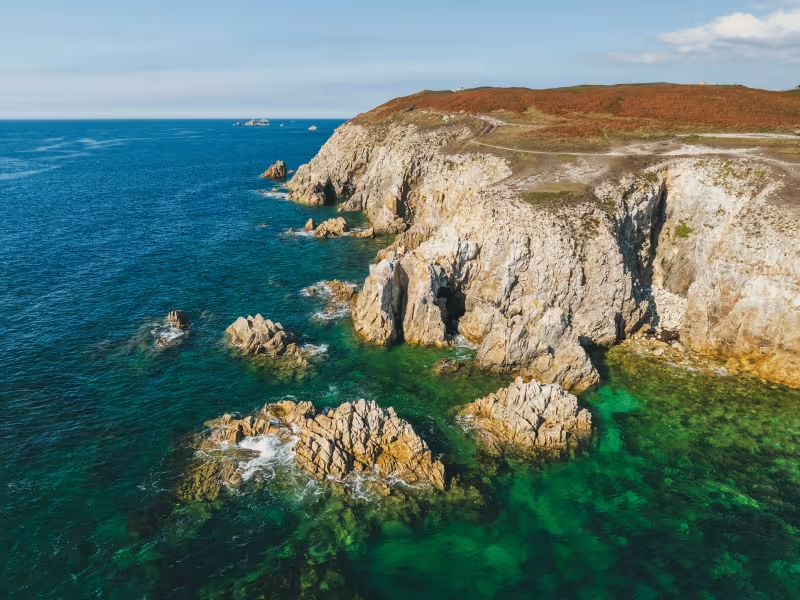
From May to October, there’s the possibility of crossing the Aber Ildut, with your bike on board an electric boat, or then make the most of the extra 14km, going all the way around the Aber, to explore the small-scale heritage beside the cycle route around Brélès (with its church and washhouses, or lavoirs). Next, you ride along close to the Pointe de Corsen, the most westerly headland on mainland France, and the theoretical dividing line between the Channel (la Manche in French) and the Atlantic Ocean. It’s really worth stopping at the Phare de Trézien, a lighthouse in the parish of Plouarzel, but this one built inland, some 500m from the coast. Continue on to the Phare de Kermorvan, the latter lighthouse standing out on the headland that bears the same name. Le Conquet, long renowned as a fishing port, operates ferries year-round to the islands of Molène and Ouessant (Ushant in English), which also feature further iconic lighthouses. Trips out to these splendid islands offer further potential exciting adventures just off La Littorale’s route.
The route
Whichever of the two options you go for, either crossing the Aber Ildut on the little electric boat, Phine la Passeuse, or riding all the way around the aber by bike, this La Littorale stage starts with quite a hill to climb to reach Lampaul-Plouarzel. Next, the coastal and rural roads you follow towards Le Conquet share the same feature, of short but demanding climbs (which may cause those with heavier baggage to dismount and push their bike for a time), notably at Porsévigné, Ruscumunoc, Porsmoguer and Illien. The last slope is just before amazing views open out onto Les Blancs Sablons, a beach. To reach the centre of Le Conquet, you need to cross a little footbridge, best negotiated on foot, allowing you to appreciate the deep inlet at this port, which is in fact built around another aber, the Aber Konk! The old town centre stands above the port, so you need to make a last effort to make this climb.
Note that during 2024, a temporary diversion via country roads is in place around the Anse d'Illien (in the parish of Ploumoguer), as the site has been undergoing renovation works.
Gradients and elevation
Slope breakdown
Road types
- Cycle path
- Routes reserved for cyclists and pedestrians (greenways, cycle tracks, towpaths), separated from cars for maximum safety.
- Shared road
- Quiet minor roads with little traffic (unless otherwise stated in the stage details). Shared with cars (stay alert).
- Not specified
- Data unavailable or being assessed. Please refer to the detailed stage description.
- Provisional
- Section on a road or cycle path awaiting better-quality facilities (see stage details).
Surface
- Smooth
- Asphalt, tarmac or smooth concrete. Optimal comfort.
- Rough
- Fine gravel, compacted stabilised surface or worn tarmac. Less comfortable, vibrations possible.
- Natural
- Dirt, grass, roots or stones. Under 5%: short sections with little impact. Higher percentage: route suited to mountain or gravel bikes only.
- Not specified
- Data unavailable or being assessed. Please refer to the detailed stage description.
Road types
- Cycle path
- Routes reserved for cyclists and pedestrians (greenways, cycle tracks, towpaths), separated from cars for maximum safety.
- Shared road
- Quiet minor roads with little traffic (unless otherwise stated in the stage details). Shared with cars (stay alert).
- Not specified
- Data unavailable or being assessed. Please refer to the detailed stage description.
- Provisional
- Section on a road or cycle path awaiting better-quality facilities (see stage details).
Don't miss
- Pointe de Corsen, the most westerly headland on mainland France
- A guided tour of the Phare de Trezien lighthouse
- The Presqu'île de Kermorvan, a peninsula with a lighthouse to visit
- Le Conquet: an historic port designated a Petite Cité de Caractère for its fine heritage; the main ferry port for boats to the islands of Molène and Ouessant (Ushant in English)