13 stages · 653 km

Gradients and elevation

Ascents: 4617m
Descents: 4659m
Lowest point: 0m
Highest point: 669m

Road types

419km (64%) By road
235km (36%) Cycle path

Surface

54km (175%) Smooth
8km (25%) Unpaved

13 stages used

Biarritz / Urt

1 Biarritz / Urt

31 km
2 h 02 min
I begin
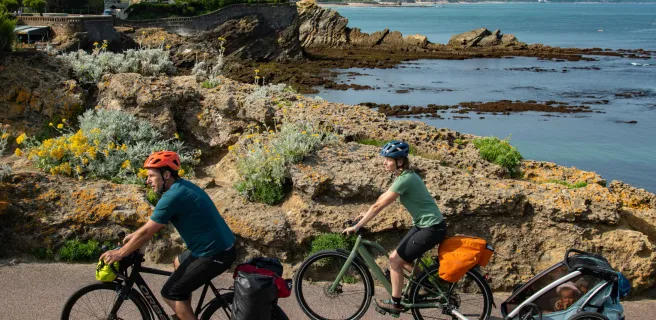
Starting from the Grande Plage de Biarritz, the main beach in this famed resort, the Vélosud offers a dreamy setting for you to capture the beginning of your Pyrenean cycling adventure on camera. Along the first stretch, you share the same route as the Vélodyssée (EV1) cycle route, passing prestigious hotels and villas as you ride through the Quartier du Phare, around the lighthouse. Continuing northwards you ride alongside the parish of Anglet’s beaches, the coastline here much straighter and sandier. Reaching the Adour Estuary, the coast-hugging start to your cycling journey comes to an end. The Vélosud now makes you turn your back on the Atlantic for good, guiding you east along the banks of the river, with, as your very distant destination, the Mediterranean! More immediately, a stop in the highly picturesque streets and lanes of Bayonne proves a joy for those who appreciate historic yet lively towns. Then continue riding beside the Adour, the best option for cycling in peace, avoiding any slopes, up to the village of Urt, with its old fishing harbour.
Urt / Salies-de-Béarn

2 Urt / Salies-de-Béarn

47 km
3 h 06 min
I cycle often
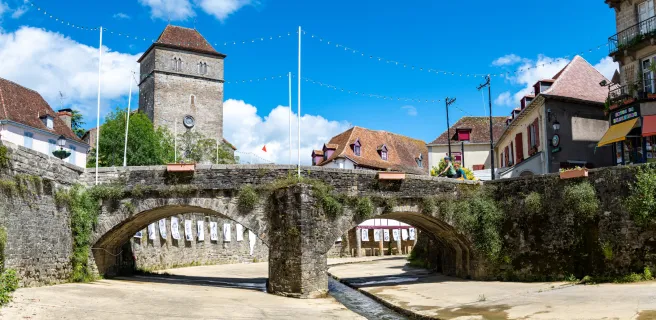
This second stage on the cycle route begins by taking you meandering merrily along the banks of the Adour River and through barthes, Aquitaine’s answer to polders, excellent for bird-watching. From Guiche onwards, a tributary of the Adour called the Bidouze acts as your guide, as you stick to its side to avoid the slopes of the Pyrenean foothills here. The towpath, reserved for non-motorized traffic, leads you through rural parts, mirroring the curves along the canalized river. Almost half-way through this stage, consider a heritage stop at Bidache. Then your ride takes you up to the typical white-washed village of Came, causing you to change gear, as you head towards the old province of Béarn. Castles and watch towers greet you as you enter this historic region associated with feisty local lord Gaston Fébus, who gained control of it in the 14th century, while a much-appreciated greenway enables you to ride easily along the Gave d’Oloron Valley to reach Salies-de-Béarn, both an historic salt-producing town and a thermal spa resort, dotted with architectural delights.
Salies-de-Béarn / Orthez

3 Salies-de-Béarn / Orthez

19 km
1 h 14 min
I cycle often
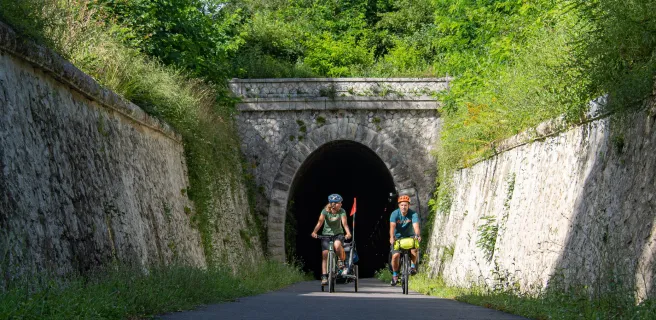
On this stage, a short link across the old province of Béarn takes you from Salies-de-Béarn, an historic salt-producing town known as the Cité du Sel, to Orthez, once capital of the viscounts of Béarn. A former railway line recently converted for cyclists, including a long but well-lit tunnel, means the local slopes are simply eradicated in one fell swoop for you, taking you smoothly through to the Gave de Pau Valley! The powerful river here is fed by the snows and springs high up in this part of the Pyrenees. Now, and for some time to come, the Vélosud follows this waterway’s course, today leading you as far as Orthez, on the next stage as far as Pau, the stage after that as far as Lourdes. In these open parts well suited to agriculture, you may spot how even kiwis are now being cultivated, as well as admiring the old-style architectural heritage. A small detour takes you to the ruined medieval castle of Bellocq, with the old church entrance to admire as well, while the beautiful typical Béarn houses in Bérenx make quite a sight, along with the village’s old mills. By Sainte-Suzanne, you can feel the pull of the town of Orthez, which you enter in wonderful manner, via a cobbled street and a medieval bridge.
Orthez / Pau

4 Orthez / Pau

55 km
3 h 38 min
I cycle often
You spend this entire day’s cycling along the Valley of the Gave de Pau (the way involving some of this river’s tributaries too), going from one capital of the old province of Béarn to another, so from Orthez, the historic capital, to Pau, the modern one, the latter capital of the département (French county) of Pyrénées-Atlantiques. This part of the cycle route brings to mind historic knightly cavalcades led by the powerful viscounts of Béarn in medieval times. First, you cross a rural section, riding to the little town of Mourenx via Biron’s lacs des barthes (polder lakes) and the tranquil Geu Valley. Next, you cycle peacefully along the banks of the Gave de Pau. This stretch of the cycle route offers a mix of greenway beside the river and detours via the villages of Tarsacq, Arbus and Artiguelouve, leading you closer to Pau without any particular difficulty. Then, thanks to an unbroken, segregated cycle way following the river’s banks and going through public gardens, your arrival in the county’s headquarters proves surprisingly serene. Reaching the faubourgs de Jurançon, in the outskirts, you’re suddenly afforded a splendid view of the Château de Pau – the town’s historic, once royal, centre is within easy reach from here.
Pau / Lourdes

5 Pau / Lourdes

50 km
3 h 20 min
I cycle often
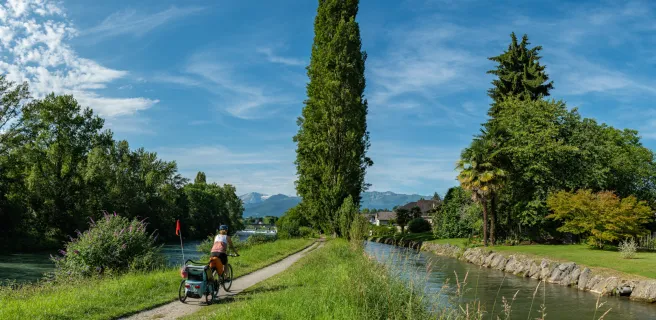
Guiding you from Pau to Lourdes, and from the old province of Béarn to that of Bigorre, the Vélosud cycle route sticks to the banks of the Gave de Pau River, as you’ll have noted, a major mountain torrent that starts up in the high mountains around Gavarnie. The way out of Pau offers some 10km of refreshing cycling, following the river’s trail. Riding on through fertile plains, you soon arrive at Nay, a charming medieval grid-plan little bastide town that’s been designated a Cité de Caractère for its attractions… which include a midday pause for cyclists! You then cross from one département (French county) to another, from the Pyrénées-Atlantiques to the Hautes-Pyrénées, spotting the typical Béarn architecture at Lestelle, then the Bigorre style evident at Saint-Pé. Plus, there are the subterranean treasures of the Grottes de Bétharram to explore. Finally, you’ll feel the pull of some minor slopes as you approach Lourdes, a magnet for visitors from around the globe.
Lourdes / Lannemezan

6 Lourdes / Lannemezan

83 km
5 h 33 min
I cycle a lot
Leaving Lourdes, the Vélosud cycle route leads you northwards through the Echez Valley, towards Tarbes. As the evolution of the Pyrenean Range also created a lot of foothills full of steep slopes and geological folds that only the Adour River has managed to cut a sensible path through, we’ve sought out this gentle way leading you via the northern part of the département (county) of Hautes-Pyrénées. Getting through the town of Tarbes means crossing the Adour, an impetuous torrent, its waters starting at the Pic du Midi de Bigorre, an iconic mountain summit not just in the Tarbes area, but right across the old province of Bigorre. Next, the cycle route makes you embark on a ride across a series of hills connecting parallel valleys that have cut a path through the northern edge of the Lannemezan Plateau. There’s no way of hiding it, the accumulation of relatively small shifts in altitude does start to add up by the end of the day. However, if the weather is fine, the views across the Pyrenees brings joy each time you reach the top of a hill.
Lannemezan / Saint-Gaudens

7 Lannemezan / Saint-Gaudens

62 km
4 h 09 min
I cycle often
On this stage of the Vélosud cycle route, you ride into the valley of the Neste, a river that has raced down from the mountains above the Aure and Louron Valleys. The Vélosud takes you on an undulating path through wooded foothills. The reward for some quite demanding climbs is to be able to visit a series of peaceful villages. The Neste and the cycle route end up by joining the Garonne, the iconic major river fed by the northern Pyrenees, at the border of the département (French county) of Haute-Garonne. After passing very close to the Grotte des Gargas, natural caves revealing traces of human occupation in prehistoric times, you can also explore the Roman ruins and the majestic cathedral at Saint-Bertrand-de-Comminges. In these parts so marked by constructions recalling the layers of civilization in the Pyrenees, it’s interesting to note that you’re pretty much at the halfway point along the V81 cycle route, equidistant between Atlantic and Mediterranean. All told, this is a stage to lift the spirits, and you finish the day on the north bank of the Garonne, going up to the promontory on which the town of Saint-Gaudens stands out.
Saint-Gaudens / Saint-Girons

8 Saint-Gaudens / Saint-Girons

58 km
3 h 52 min
I cycle often
This Vélosud cycle route stage first continues to lead you beside the Garonne, following the river’s natural descent. However, at the level of Roquefort-sur-Garonne, while the mighty Garonne continues to distance itself further from the Pyrenees, our cycle route branches off into a tributary valley, that of the Salat River. You’re now heading for the Couserans area and the département (French county) of Ariège. You follow the Salat upstream along a comfortable greenway, up to your stop-over point, either Saint-Lizier or Saint-Girons. Along this stretch of the Pyrenean foothills, have fun spotting a series of châteaux and manors – some ten of them – recalling the historic prosperity in these fertile valleys. It’s worth considering some easy breaks along the way at remarkable heritage sights, at Lestelle, Saint-Martory, in the thermal spa resort of Salies-du-Salat, or in the village of Caumont. And do have a good wander around the unmissable little bishops’ city of Saint-Lizier.
Saint-Girons / Foix

9 Saint-Girons / Foix

46 km
3 h 02 min
I cycle often
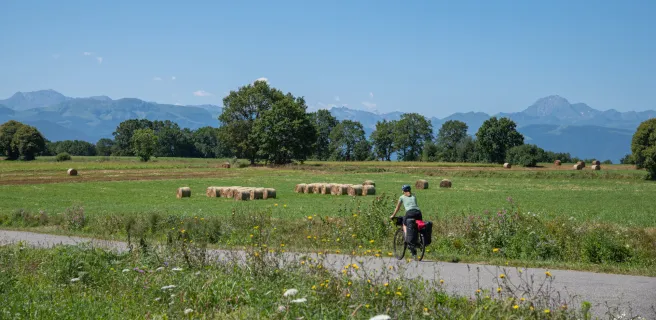
Between Saint-Girons and Foix, the Vélosud escapes the Salat Valley and then dawdles happily through the Parc Naturel Régional des Pyrénées Ariégeoises, guiding you via country parts, making use of the converted old railway line leading to the diminutive administrative capital of the Ariège département, Foix. Enjoy taking your time, riding along from the Baup Valley to the Arize Valley, shaded by trees, meadows to either side often covered with hay bales, with the odd heritage stop or charming village at which to halt in this, the Séronnais area. After La Bastide-de-Sérou, the route climbs gently into wooded Pyrenean foothills concealing a remarkable curiosity that you should try to visit – the underground river of Labouiche. Return up to the sunlight to enjoy the descent to the characterful little county capital of Foix. You enter the place via the gentle banks of the Ariège River and can then explore the narrow lanes of the old town, dominated by the imposing Château de Foix.
Foix / Mirepoix

10 Foix / Mirepoix

47 km
3 h 08 min
I cycle often
This second stage in a row fully within the département (French county) of Ariège guides you from the little county capital of Foix to the historic bastide town of Mirepoix, but avoiding the shifts in altitude involved were you to tackle the famed Cathar strongholds of Roquefixade and Montségur. The Vélosud cycle route, in order to do this, sticks to the banks of the Ariège River and the surrounding plain. You get across the geological barrier presented by the Plantaurel foothills, running parallel to the high Pyrenees in the county of Ariège, with minimal effort and can then ride on through the wide, open spaces of Varilhes and Pamiers, where the Ariège River takes its time, moving languidly in broad meanders. The town of Pamiers offers a lovely place to enjoy a heritage pause, before the cycle route branches off east to lead you on into the next, more rustic valley, the natural corridor of the Hers Valley. A well-laid-out cycle path guides riders from one hamlet or village to the next, with delightful discoveries to unearth along the way. Then you make your grand entrance into the splendid medieval town of Mirepoix, in almost knightly style on your bike!
Mirepoix / Couiza

11 Mirepoix / Couiza

53 km
3 h 25 min
I cycle often
Surprisingly, it’s only this far east along the Vélosud cycle route, on one of its final stages, that you cross a highly important geographical frontier in the Pyrenean foothills – the watershed separating the river waters that head for the Atlantic, to the west, from those that flow to the Mediterranean, not that far east. From beyond the Col des Tougnets, a pass close to Puivert Castle, the rivers you’re going to follow from now on all run down towards the Med. But before that, starting along this stage, you ride along a greenway taking you further through the secretive Hers Valley, the way marked by the feudal castle of Lagarde and heritage stops at Camon and then in the grid-plan bastide town of Chalabre, already in the département (French county) of Aude. The next stop is Puivert, with its château and museum to visit, before you cross the aforementioned watershed, to head along the long, bucolic Faby Valley up to Couiza.
Couiza / Saint-Paul-de-Fenouillet

12 Couiza / Saint-Paul-de-Fenouillet

38 km
2 h 30 min
I cycle a lot
For you to cross by bike from the département (French county) of Aude to that of Pyrénées-Orientales, the Vélosud cycle route makes use of the Sals Valley, the river’s waters here said to have well-being properties. As the name Sals indicates, this river is rich in salt, and you might consider stopping at the thermal spa of Rennes-les-Bains for a well-deserved treatment to relax your tired limbs after so much cycling! Reinvigorated, you can then set off on the climb to the Col du Linas, a pass below the mysterious Pech de Bugarach Mountain, and the highest point on the whole Vélosud route, taking you to an altitude of 667m above sea level. Then you follow the Agly River all the way to the Mediterranean. This mountain stream passes through forests relatively calmly for a time but after a few kilometres transforms into a raging torrent as it squeezes through the impressive, beautiful Gorges de Galamus. All told, this may be a short day’s cycling, but it’s intense!
Saint-Paul-de-Fenouillet / Barcarès

13 Saint-Paul-de-Fenouillet / Barcarès

65 km
4 h 20 min
I cycle often
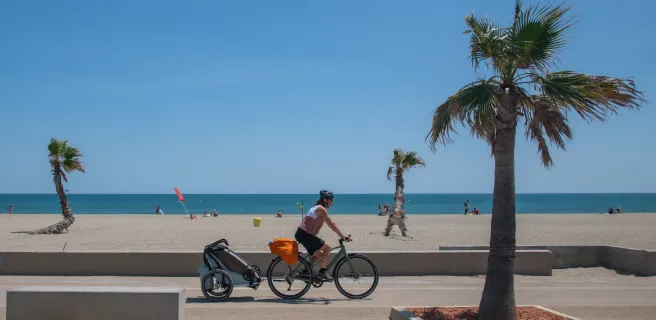
On this final stage of the Vélosud cycle route, you continue riding along the Agly Valley. You already got to know this river closely on the stage before, for example riding through the Galamus Gorges, but this mountain torrent now changes character, turning into a coastal river as it heads for the Mediterranean. Riding through luminous limestone landscapes, there are two relatively modest climbs to tackle, the Coll du Pourtell pass and the Serra de la Gironella, allowing you to spot the summit of that iconic Pyrenean mountain close to the coast, Le Canigou, before you get glimpses of the Mediterranean coast. Crossing these parts links up Maury’s vineyards, the picturesque historic village of Tautavel, and Rivesaltes, with its fortifications. We recommend you take a break at these places before finally setting your bike down on the sands of Le Barcarès and its beaches at the end of this great Pyrenean cycling adventure!
Afficher les étapes