4 stages · 62 km

Gradients and elevation

Ascents: 170m
Descents: 77m
Lowest point: 32m
Highest point: 146m

Road types

15km (24%) By road
48km (76%) Cycle path
21km (33%) Provisional itinerary

Surface

20km (200%) Smooth

4 stages used

Caderousse / Orange

1 Caderousse / Orange

10 km
1 h 21 min
I begin
On the ViaRhôna cycle route, at the level of Piolenc, continue first along this cycle route in the direction of the village of Caderousse, nestling in a former, older branch of the Rhône River, with an imposing levée or embankment worth seeing. From this village, make for the town of Orange, riding along quiet roads shared with motorized traffic. Then, explore the town’s exceptional historical vestiges, with its superb Roman triumphal arch and theatre listed as a UNESCO World Heritage Site. Note that from summer 2024, it will in fact be possible to reach Orange directly from Piolenc and its artificial lake (or plan d'eau) via a road shared with motorized traffic, followed by a footbridge over the Aigues River. At time of writing, this footbridge was being worked on, and therefore not open to cyclists or pedestrians.
Orange / Carpentras

2 Orange / Carpentras

24 km
1 h 40 min
I begin
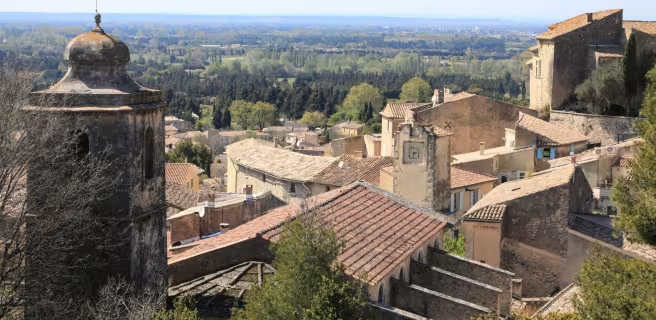
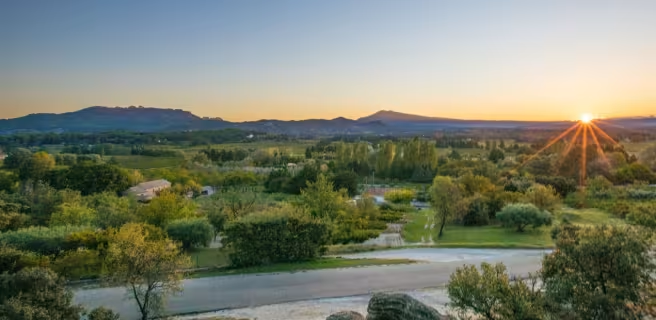
Onwards to Carpentras, a town known for having the oldest synagogue in France, as well as producing culinary specialities, notably fine strawberries and berlingots, traditional boiled sweets with provençal flavours. On this stage, the Via Venaissia leads you away from the Rhône, splendid views opening up onto the Massif des Dentelles de Montmirail, a remarkable, jagged hill range, and the Mont Ventoux, the Giant of Provence, notorious as a punishing judge of even the fittest of cyclists on the Tour de France (nicknamed by celebrated journalist Albert Londres as “les forçats de la route”, or “slaves of the road”). At Loriol du Comtat, the Aqueduc des 5 Cantons draws your attention, forming a vital part of this town’s irrigation system, along with the Canal de Carpentras. On a stop-over, relish local specialities derived from the vines, olive groves and almond trees you’ve passed, bringing truly local flavour to your dining… as well as filling you with energy for an early start the following day.
Carpentras / L'Isle-sur-la-Sorgue

3 Carpentras / L'Isle-sur-la-Sorgue

16 km
1 h 05 min
I begin
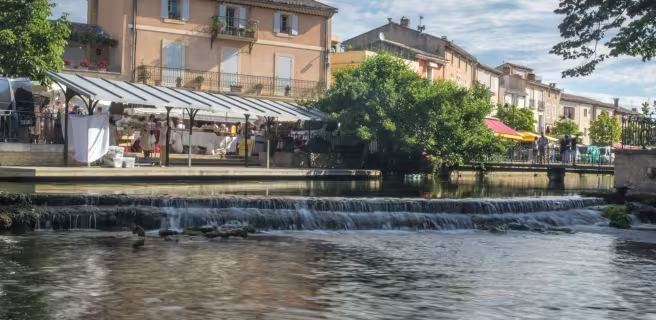
This short stage of the Via Venaissia incites cyclists to enjoy provençal life at a slow pace, discovering gem in the old town of Carpentras, even abandoning the bike for a time to saunter around the pretty provençal markets held here. Leaving Carpentras, ride on to Pernes les Fontaines, a small historic town boasting no fewer than 41 fountains and nicknamed the Perle du Comtat for its exceptional heritage, along with its fine craft traditions. Stopping in Pernes-les- Fontaines, pay homage to Paul de Vivie, nicknamed Vélocio, who spread the word about the joys of the dérailleur gear-changing system and is considered in France as the father of cycling tourism. He was from Pernes-les-Fontaines and the town has dedicated its Musée du Cycle to him; this museum displays an impressive collection of bikes! In short, it might be said that this is the place where French cycling tourism was born, so any self-respecting cyclist should consider a visit here a kind of pilgrimage! Leaving Pernes, ride on via Velleron to L’Isle-sur-la-Sorgue, nicknamed Provence’s Little Venice, a lively lovable town crisscrossed by the clear, fresh branches of the Sorgue River.
L'Isle-sur-la-Sorgue / Robion

4 L'Isle-sur-la-Sorgue / Robion

12 km
48 min
I cycle often
Between L’Isle-sur-la-Sorgue and Robion, the Via Venaissia cycle route hasn’t yet been completed at time of writing.
L'Isle-sur-la-Sorgue is a place you won’t be able to resist stopping at. A year-round magnet for antiques collectors, its weekly Sunday market offers a wonderful display of provençal colours, scents and tastes. This enchanting place hones all the senses! From town, a link via road shared with motorized traffic enables you to join up with the Méditerranée à Vélo cycle route at the level of Robion, a key junction for cyclists crossing the Luberon region. From there, you have the option of riding on all the way to Menton (a Mediterranean resort on the French-Italian border), or then continuing on a Provence-based cycling circuit, going via Cavaillon, the foot of the steep little Alpilles Range, Beaucaire and Avignon, making use of the ViaRhôna cycle route. Along the way, there’s an additional detour you can make to Lagnes, a pretty medieval village on the slopes of the Monts de Vaucluse, the little range located between Luberon and Mont Ventoux. Lagnes offers a main entry point to the extraordinary Mur de la Peste (Plague Wall), a 27km-long rampart built along the Monts de Vaucluse in a vain attempt to protect the Comtat Venaissin region from a terrible outbreak of the plague in the 18th century, this Grande Peste (Great Plague) estimated, roughly, to have killed one in four people across Provence. This epidemic was evoked by famed regional writer Marcel Pagnol (he of the renowned provençal novels Jean de Florette and Manon des Sources, turned into famous films) in an unfinished work, Les Pestiférés (The Plague-stricken).
Afficher les étapes