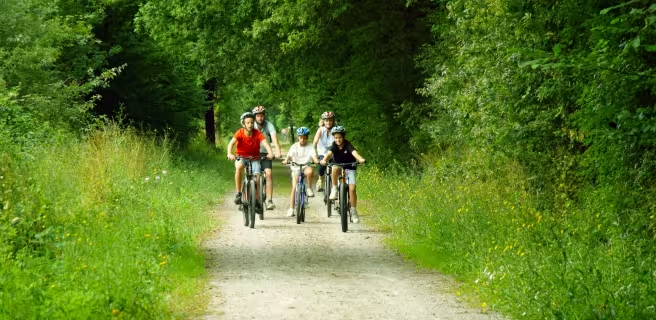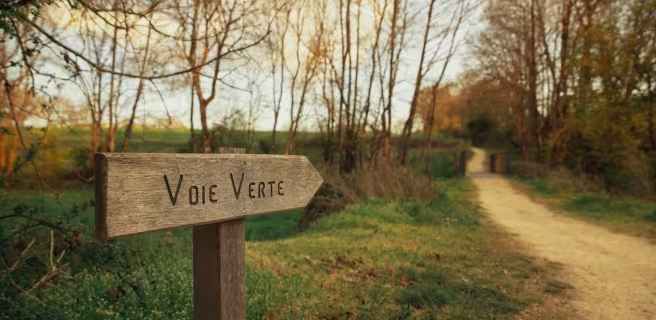
21 stages · 682 km

Gradients and elevation

Ascents: 4008m
Descents: 4747m
Lowest point: 0m
Highest point: 740m

Road types

512km (75%) By road
13km (13%) Provisional itinerary
169km (25%) Cycle path

Surface

64km (181%) Smooth
7km (19%) Unknown

21 stages used

Royère-de-Vassivière / Bujaleuf

1 Royère-de-Vassivière / Bujaleuf

35 km
2 h 20 min
I cycle often
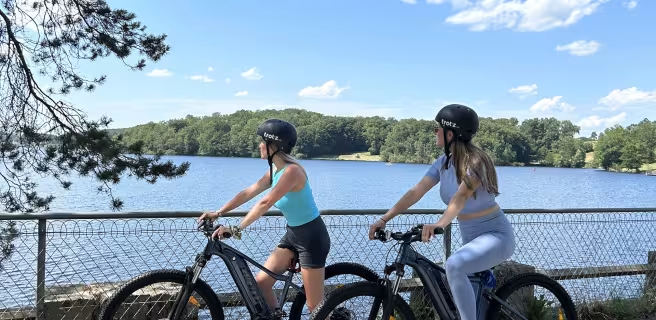
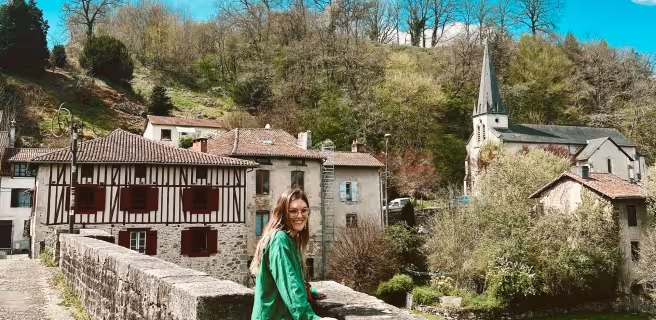
The Vélidéale cycle route starts at Royère de Vassivière in the département (French county) of Creuse and also in the midst of the Parc Naturel Régional de Millevaches en Limousin. In the early part of this stage, the Lac de Vassivière, a vast, many-branched stretch of water covering over 1,000 hectares, provides dreamy spots at which to stop for a refreshing break. Those who appreciate contemplative outdoor contemporary art should visit the Centre International d’Art et du Paysage on Vassivière Island. Then, continue riding alongside the Maulde River and, just before the stage ends, make the most of the Lac de Saint-Hélène with its beach just north of Bujaleuf.
Bujaleuf / Saint-Léonard-de-Noblat

2 Bujaleuf / Saint-Léonard-de-Noblat

18 km
1 h 11 min
I cycle often
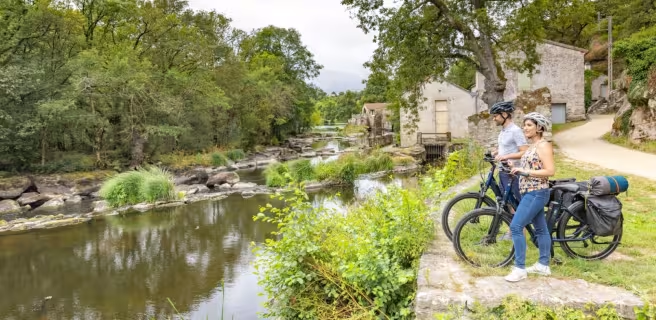
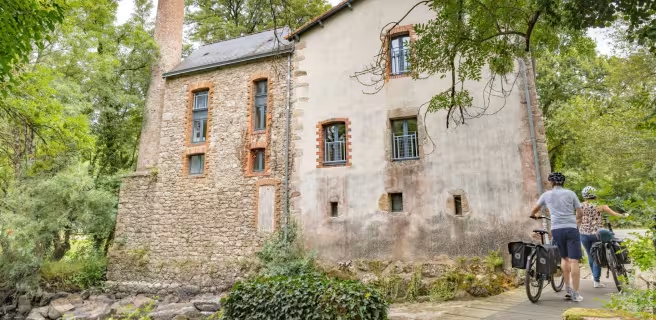
Between Bujaleuf and Saint-Léonard-de-Noblat, the Vélidéale cycle route runs beside the Maulde River (passing the Moulin de l'Artige, an historic mill), followed by the Vienne River. You ride through parts where France’s most popular cyclists of all time, Raymond Poulidor, used to train. In the town of Saint-Léonard de Noblat, explore shopping streets that Poupou, as he was nicknamed, loved so much. You’ll arrive at the foot of the collegiate church that forms part of the wider UNESCO World Heritage Site singling out fine monuments along the Santiago de Compostela pilgrimage route. Also taste a massepain, an almond marzipan speciality made here, a sweet top-up that should give you an energy boost!
Saint-Léonard-de-Noblat / Limoges

3 Saint-Léonard-de-Noblat / Limoges

28 km
1 h 51 min
I cycle often
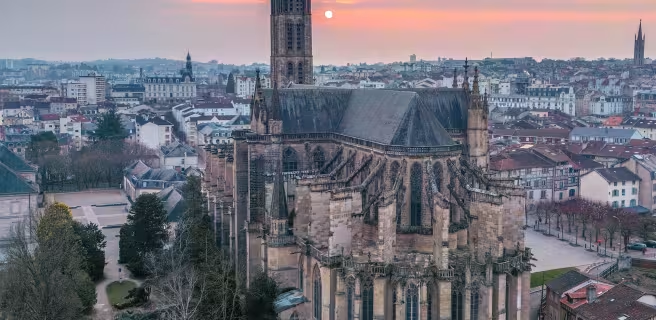
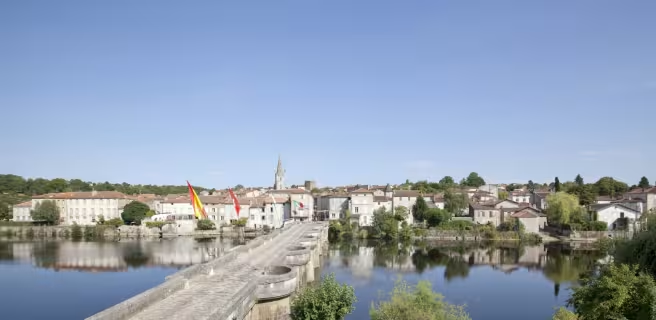
Leaving Saint-Léonard de Noblat for Limoges, the Vélidéale continues to lead you beside the Vienne. This river has deeply marked the landscapes around here, as well as supplying all manner of mills with power, such as the Moulin du Got (a 10-minute ride out), still making paper the old-fashioned way. And to see how cleverly cartoonists can turn paper into art, stop to visit the Centre International de la Caricature et du Dessin d'Humour at Saint-Just-le-Martel, where you can enjoy a good laugh at the same time as resting your pins! The cycle route guides you into the city of Limoges via a fine historic bridge, the Pont Saint-Martial. Do explore the cathedral quarter, among others, with the Bishops’ Garden, or Jardin de l'Evêché, a wonderful place to relax and take in views of Limoges before tomorrow’s cycling stage.
Limoges / Aixe-sur-Vienne

4 Limoges / Aixe-sur-Vienne

20 km
1 h 19 min
I cycle often
The Vélidéale cycle route continues to guide you through the old Limousin Region, going from Limoges to Aixe-sur-Vienne, once again along the well-laid-out banks of the Vienne River. For cyclists working up an appetite along the way, the Limousin restaurants on this stage make for excellent places to stop and savour high-quality local produce. Before leaving the old capital of the Limousin, Limoges, do feast first on its historic quarters, such as those around Place des Halles or the Quartier de la Boucherie and the Musée National de la Porcelaine Adrien Dubouché… but further cultural morsels will also attract your attention along this stage. Along a stretch of greenway, make the most of Vaseix Forest (a county forest with 105 hectares and criss-crossed by trails), a perfect spot for a shaded picnic before reaching Aixe-sur-Vienne.
Aixe-sur-Vienne / Rochechouart

5 Aixe-sur-Vienne / Rochechouart

40 km
2 h 39 min
I cycle often
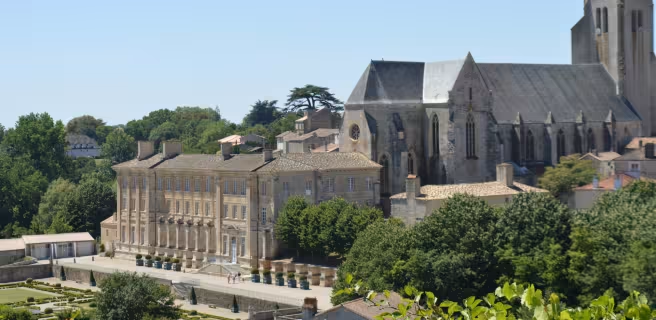
Between Aixe-sur-Vienne and Rochechouart, the Vélidéale cycle route continues to guide you along beside the Vienne; you only leave the river at the end of this stage, at the level of St-Brice-sur-Vienne. Along the way, Saint-Yrieix-sous-Aixe is a charming little town that makes for a perfect place to stop for lunch. As to the Étang de la Pouge, a lake at Saint-Auvent in the midst of the Parc Naturel Régional du Périgord Limousin, and a protected Natura 2000 site, it offers idyllic surrounds to ride around. From its observatory, spot the many species of birds that rest and nest here. Finally, you draw close to the little town of Rochechouart, dominated by its magnificent château guarding the valley, the place now open to visitors as the Musée Départemental d’Art Contemporain.
Rochechouart / Confolens

6 Rochechouart / Confolens

38 km
2 h 33 min
I cycle often
Between Rochechouart and Confolens, our cycle route takes you through an unusual area marked by the impact made by a meteorite smashing into Earth some 214 million years ago. This geological event is even reflected in the local architecture, which has made use down the centuries of the impact breccia, or fragments of rock fused together as a result of the cataclysmic event. The Vélidéale takes you close to Lac de Lavaud (where it also joins up with the Scandibérique cycle route), one of two lakes in the Haute Charente area where you can enjoy both bird-watching (notably at the Observatoire de Foucherie) and outdoor leisure activities. Note that a few kilometres away from the cycle route itself, at Chassenon, you can go and visit some of the largest and best-preserved vestiges of Gallo-Roman thermal baths in France. Next, you continue to ride along the charming Vienne Valley, crossing the river at Exideuil, a village whose little Romanesque church is a listed historic monument.
Confolens / Champagne-Mouton

7 Confolens / Champagne-Mouton

36 km
2 h 23 min
I begin
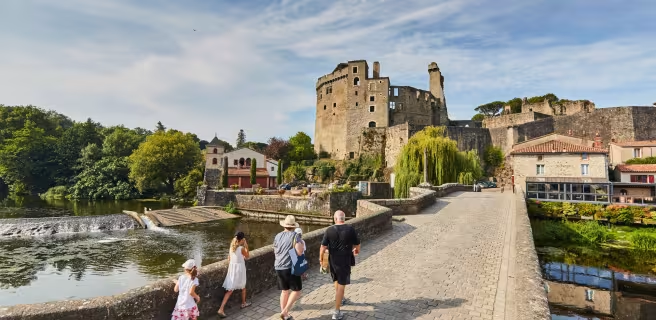
The little town of Confolens makes an irresistible stopover along the Vélidéale cycle route. It boasts remarkable heritage features that it puts lovingly to the fore, hence its designation as a Petite Cité de Caractère. A trail incites you to learn about the varied curiosities dotted around the medieval settlement. For the last 60 or so years, the weekend around 15 August sees the arrival of dancers and musicians from around the world for its Festival d'Art et de Traditions Populaires. Leaving Confolens, you once more follow the Vienne River, up to Saint-Germain de Confolens, a village whose sublime castle perched on its rocky promontory dominates a wide area. Then our cycle route heads off straight westwards to cross the Charente River at Alloue, where the Maison Maria Casarès stands out, a fortified medieval house lived in by a famous French actress from 1961 to 1996, and now an artists’ residence. Ride on to Champagne-Mouton, a little place, but where you’ll find stores to stock up on provisions.
Champagne-Mouton / Ruffec

8 Champagne-Mouton / Ruffec

32 km
2 h 08 min
I cycle often
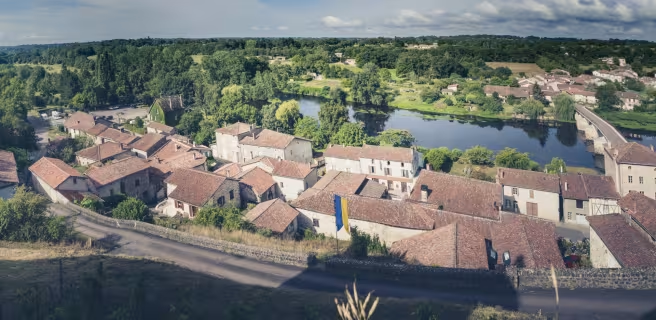
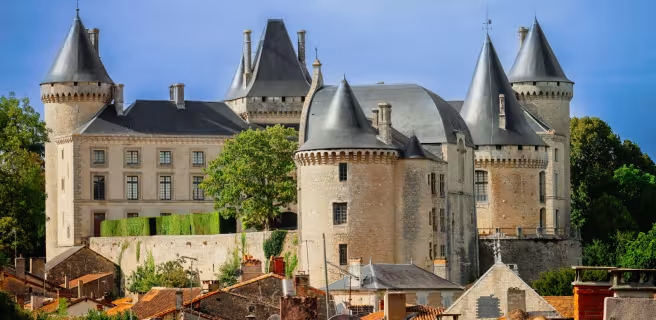
Your cycling adventure continues on towards Ruffec, taking you via two further Petites Cités de Caractère, Nanteuil-en-Vallée and Verteuil-sur-Charente, each inviting you to enjoy a refreshing pause. Nanteuil-en-Vallée, with its cobbled streets and typical historic Charentais-style houses, is full of charm, its main attractions the vestiges of its medieval abbey and a 1920s garden, the Jardin de l'Argentor. As to Verteuil-sur-Charente, its impressive château looks down on the Charente River, while its Romanesque church conceals one of the Charente’s most dramatic Entombment of Christ scenes, featuring life-size terracotta figures. Next, it’s on via the village of Barro to Ruffec, the first offering tranquillity, the second shops, so that you can regather strength before riding onwards.
Ruffec / Chef-Boutonne

9 Ruffec / Chef-Boutonne

40 km
2 h 39 min
I cycle often
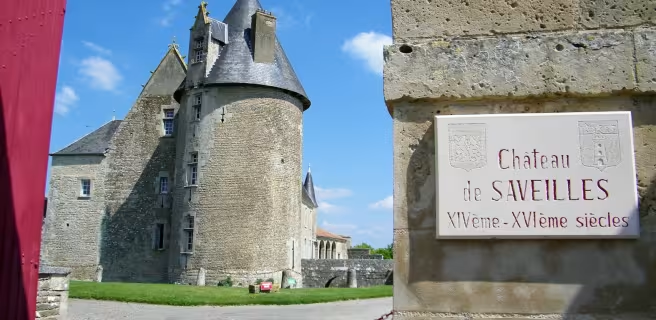
The Vélidéale cycle route guides you from the département (French county) of Charente into that of Deux-Sèvres to enter the Mellois area, riding along bucolic little country roads. Dotted along the way are little gems that will pique your interest: in Raix, the Romanesque church of Saint-Barthélemy; in Paizay-Naudouin-Embourie, the 14th-century Château de Saveilles, displaying an intriguing mix of medieval fort and later, Renaissance style; and in Chef-Boutonne, the Château de Javarzay, one of the earliest Renaissance châteaux to be built in the old region of Poitou. Chef-Boutonne was also the birthplace of a pioneering 19th-century French industrialist, Jean-François Cail, who built metallic structures and an industrial farm as well as advocating social responsibility. All told, this unexpected local heritage will satisfy the curiosity of cyclists who like to learn as they ride along!
Chef-Boutonne / Melle

10 Chef-Boutonne / Melle

33 km
2 h 11 min
I cycle often
From Chef-Boutonne, the Boutonne Valley serves as your thread along a route with a royal twist; the Pays Mellois area boasted silver mines exploited for the French kings... back in Carolingian times! Today, you can cover this territory on a family-friendly, refreshing stage that runs beside local rivers. This part of the Vélidéale cycle route encourages you to discover Romanesque architecture and enjoy breaks in green settings. After the Boutonne River, it’s the turn of the Béronne River to guide you up to the little town of Melle via an interweaving series of pretty minor roads that it’s a delight to meander along.
Melle / Niort

11 Melle / Niort

37 km
2 h 27 min
I cycle often
On this stage of the Vélidéale cycle route, you ride off from the Pays Mellois area making use of a greenway called the Ruban Vert (or Green Ribbon), taking you along a raised former railway line, up to Prahecq. This stretch proves both peaceful and accessible to most. Then, to shift from the Mellois area to the Niortais, it’s only a short stretch, through a tunnel of greenery in the warmer seasons. You reach the centre of the city of Niort via the Avenue de Limoges, cycling up to La Brèche, a major public park, and Le Port Boinot, the river port, both providing important green spaces for the town. Plus, you’re now on the edge of the splendid Marais Poitevin marshes.
Niort / Champdeniers

12 Niort / Champdeniers

26 km
1 h 43 min
I cycle often
Leaving Niort, the Vélidéale shares the ride to the town of Parthenay with another western French cycle route, La Vélo Francette. At the level of Echiré, gourmets among you may which to leave the route to stop at the Atelier de l'Excellence du Beurre d'Echiré (dedicated to the fine butter made here, and its multiple uses), while later on, all will want to admire the Château du Coudray-Salbart as you reach Ternanteuil. The stage ends at Champdeniers-St-Denis, which has some small-scale architectural delights for you to uncover.
Champdeniers / Parthenay

13 Champdeniers / Parthenay

29 km
1 h 55 min
I cycle often
Riding from Champdeniers to Parthenay, you’ll cross the beautiful village of Saint-Marc-la-Lande which boasts a magnificent collegiate church, a commandery (once owned by a military religious order), a medieval-inspired garden and a conservation orchard. As you cycle on further, note how granite stone gives way to limestone as you enter an area known as the Gâtine Poitevine. Riding merrily along, you’ll be delighted to encounter a charming village or two, a mysterious river, a legendary centaur, a ford, old landscapes composed of hedge-divided fields, a medieval town... Arriving at Saint-Pierre-de-Parthenay-le-Vieux, admire the sublime church, its construction even attributed by legend to the Fairy Mélusine… Reaching the outdoor leisure centre, or Base de Loisirs, at Parthenay, dismount to enjoy a picnic on the banks of the Thouet River before heading into town to discover its historic centre and fine heritage.
Parthenay / Bressuire

14 Parthenay / Bressuire

34 km
2 h 18 min
I cycle often
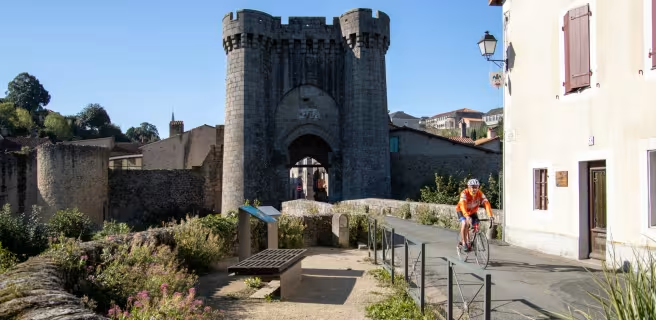
Parthenay boasts an historic quarter with some 100 timberframe houses, and puts in a claim for Rue de la Vau Saint-Jacques being the longest medieval street to have survived in Europe. As a cyclist, imagine transporting yourself back to lordly times here! Wander around the winding streets and you’ll encounter wonderful views. Climb to the top of the ornate Porte Saint-Jacques and from on high you can admire the green, undulating countryside that typifies the Gâtine area. The old railway station proves a perfect place for a picnic and to refresh yourself, even to sit reading for a time, enjoying one of the selection of books left for passers-by to peruse, before you head off along the greenway towards Fenery, and then on to Bressuire.
Bressuire / Nueil-les-Aubiers

15 Bressuire / Nueil-les-Aubiers

16 km
1 h 06 min
I begin
An exceptionally easy cycling stage, going from Bressuire to Nueil-Les-Aubiers, using the former railway line linking the two towns. You wend your way through the Bocage Bressuirais, the hedge-divided patchwork of fields in these parts, sometimes riding above it, enjoying 360° views. From this greenway, you’ll spot the former railway station at Voultegon. Just a little detour by bike and you can make the most of a restful pause at the Voulmentin picnic area (Quartier de Voultegon). After enjoying a break, continue along the greenway to Nueil-Les-Aubiers.
Nueil-les-Aubiers / Mauléon

16 Nueil-les-Aubiers / Mauléon

20 km
59 min
I begin
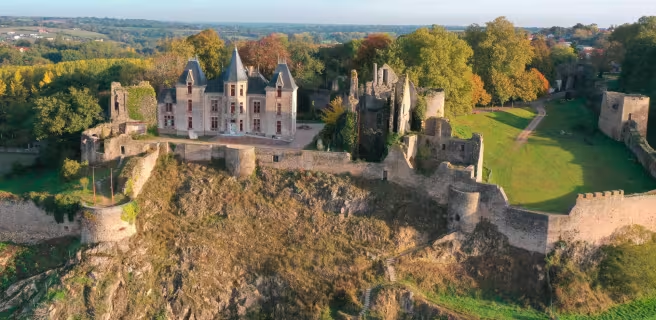
From Nueil-Les-Aubiers, awaiting the laying out of a continuous greenway into the next département (French county) of Maine-et-Loire, the Vélidéale cycle route leads you along green paths characteristic of the bocage (hedge-divided patchworks of fields) up to Mauléon. At the level of Saint Aubin de Baubigné, you can take a little detour by bike to reach the atmospheric, ruined Château de La Durbelière. As to the small town of Mauléon, it’s been designated a Petite Cité de Caractère for its historical architecture. It’s a restful place to take a break, unless you feel the desire to head off to discover the nearby Espace Naturel Sensible (ENS), La Corbelière de Moulins, exploring the rustic landscapes of this protected, unspoilt area.
Mauléon / Mortagne-sur-Sèvre

17 Mauléon / Mortagne-sur-Sèvre

31 km
2 h 05 min
I cycle often
After Mauléon, you ride off in the direction of the département (French county) of Vendée, making use of a cycle path taking you on to a network of small roads that then lead you along the valley of the Sèvre Nantaise River. Do take time to explore the lanes of Mallièvre, a former weavers’ village that has now been designated a Petite Cité de Caractère for its heritage. Next, the Vélidéale cycle route guides you along the Poupet Valley via a mix of paths and very small local roads, making you cross from one side of the river to the other. Before reaching Mortagne sur Sèvre, there are spots at which to enjoy pretty views over the Sèvre Nantaise and you’ll even get a glimpse of the majestic Barbin Viaduct, creating a picture-postcard scene.
Mortagne-sur-Sèvre / Clisson

18 Mortagne-sur-Sèvre / Clisson

39 km
2 h 34 min
I cycle often
Enjoy a cascade of viewpoints over the Sèvre Nantaise Valley on this Vélidéale cycle route stage. Many mills were built along the banks of the river here, exploiting its sometimes very lively character, often for preparing flour or textiles. There are several nice spots to pause at beside old mills dotted along this undulating stretch that guides you through the hedge-divided patchwork of fields that makes up the Bocage Vendéen. The main stop along this stage is the arresting Château de Tiffauges, the largest medieval fort in central western France. Wending your way from Cugand to the little village of Gaumier, you arrive at the only fulling mill in France still in operation. Reaching the end of the stage, you arrive at Clisson, a very pretty valley town largely rebuilt in Italianate style after the French Revolution.
Clisson / Nantes

19 Clisson / Nantes

41 km
2 h 42 min
I cycle often
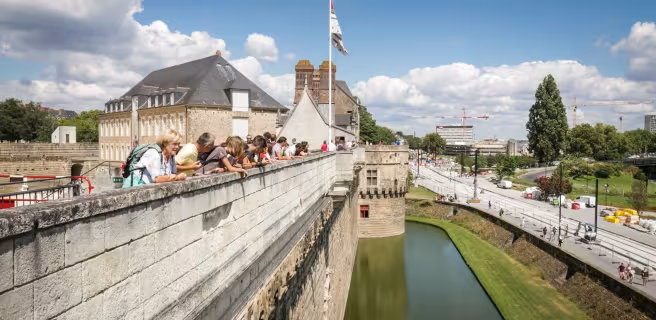
With its varied atmospheres, one part marked by its imposing medieval castle, the other by the Tuscan airs around La Garenne Lemot (an Italianate villa), Clisson is also, surprisingly, home to one of Europe’s largest and loudest musical festivals, heavy-metal Hellfest! Continuing from Clisson to Nantes, the Vélidéale dawdles through the Muscadet area’s vineyards, with lovely bucolic views not just of vines, but also of delightful heritage sites dotted along the Sèvre Nantaise Valley, including the Gué du Moulin d’Angreviers and perched old manors. A veritable green lung on the edge of the sprawling metropolis, the river guides you right up to Nantes, past such tempting spots as La Chaussée des Moines at Vertou, where a hungry or thirsty cyclist can easily find a terrace at which to sit and be served. The green cultural trail known as the Voyage à Nantes then takes over as your guide, leading you along a path peppered with startling outdoor art installations towards the capital of central western France, Nantes. The Sèvre Nantaise River is the last major tributary to join the Loire before its estuary, reaching the mighty river at the great metropolis, after which you’ll carry on your cycle route due west beside the Loire.
Nantes / Cordemais

20 Nantes / Cordemais

49 km
3 h 14 min
I cycle often
Between Nantes et Cordemais, the Loire River serves as your guide as you cycle along. Beside the river, the village of Trentemoult, with its atmospheric, colourful houses, opens the way to a stretch of the great river dotted with fantastical, outsized works of art made for a series of exhibitions known as Estuaire. Along this portion, the Vélidéale cycle route shares the way with two other major cycle routes, the Loire à Vélo and the Vélodyssée… up until the river port of Le Pellerin, where an old-fashioned ferry takes you over to Couëron, on the north bank of the Loire. Once across, our cycle route leads you through peaceful Loire marshlands up to the port of Cordemais, with not just its EDF power station standing out, but also the Villa Cheminée, a playful work by Japanese artist Tatzu Nishi, its very startling form a great curiosity rising out of these otherwise very flat lands.
Cordemais / Saint-Nazaire

21 Cordemais / Saint-Nazaire

41 km
2 h 45 min
I cycle often
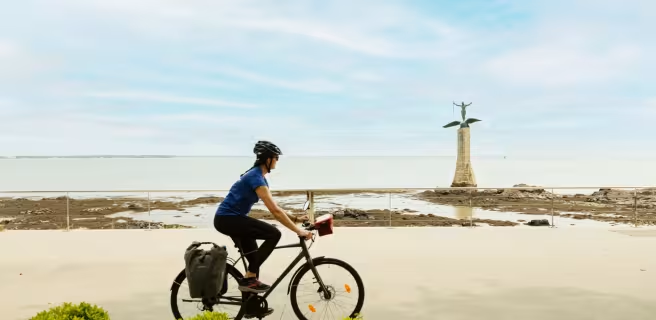
Riding between Cordemais and Saint-Nazaire, France’s longest river pretty much guides you to the Atlantic, the cycle route crossing marshlands and industrial zones. This may be your last stage on the Vélidéale…or it may be your first, if you’re tackling our cycle route in the opposite direction. Saint-Nazaire, a surprising garden city on the edge of the Atlantic, is a welcoming place. Along its coastline, there are no fewer than 20 beaches and creeks accessible to cyclists. The port itself is now France’s largest on the Atlantic. Around town, there are unusual museums to visit, plus remarkable architecture to take in, from Belle Époque to postwar reconstruction. Riding on northwestwards, you can immerse yourself in the atmosphere of France’s second-largest marshlands, the Brière. Here, birdwatchers will be in their element, as the likes of heron, tits and bluethroats find it perfect nesting territory. The Atlantic lies at the end of the Loire and the Brière, providing a fitting finale for completing this major cycle route.
Afficher les étapes