5 stages · 196 km

Gradients and elevation

Ascents: 675m
Descents: 713m
Lowest point: 0m
Highest point: 145m

Road types

112km (65%) By road
98km (50%) Cycle path

Surface

35km (72%) Smooth
15km (32%) Unknown
42km (88%) Rough
5km (10%) Unpaved

5 stages used

Angoulême / Barbezieux-Saint-Hilaire

33 Angoulême / Barbezieux-Saint-Hilaire

48 km
2 h 52 min
I begin
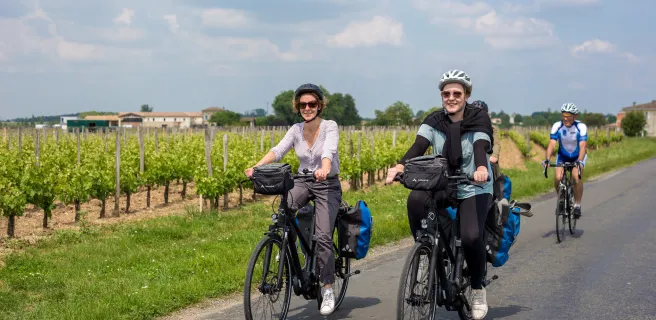
Once you’ve enjoyed your fill of cartoons in Angoulême, including on its giant painted walls, time to pick up the thread of the Scandibérique again. The route crosses the city peacefully via the Coulée Verte beside the Charente, which you continue to follow, the river’s banks dotted with little ports and locks, the slopes above producing cognac and pineau. Châteauneuf-sur-Charente is well worth a halt, one of the historic ports for transporting cognac, a spirit known around the world since 1700, and a leading French export today. The final stretch of this first stage connecting two renowned viticultural areas, the Charente and the Bordelais, continues through vineyards to Barbezieux-St-Hilaire.
Barbezieux-Saint-Hilaire / Clérac

34 Barbezieux-Saint-Hilaire / Clérac

39 km
2 h 34 min
I begin
This Scandibérique stage leads via the county of Charente’s vineyards on to forests typical of the neighbouring county of Charente-Maritime and continues to the border between the historic areas of the Saintonge and the Périgord. Cruise easily along the Galope Chopine Greenway from Barbezieux St-Hilaire to Clérac, the way increasingly wooded. The medieval Château de Montguyon, an imposing fort ravaged by time, offers a tempting reason to deviate slightly from the Haute-Saintonge greenway. Just a few arrows’ lengths further on, cycling into the heart of the Double Saintongeaise Forest (40,000 hectares of woods stretching between Montguyon, Montlieu la Garde and Montendre) you reach Clérac. This stage provides plenty of invigorating country air!
Clérac / Libourne

35 Clérac / Libourne

46 km
3 h 05 min
I cycle often
Clérac offers a haven of peace, nestled in its green wooded corner at the southern edge of the Saintonge area. The Scandibérique then leads you into the Bordelais area. At first, up to Guîtres, as well as the green of the pines, the bright white of former kaolin clay mines stands out, while the lakes that have formed in these pits reflect the deep blue of the sky. Next, the scenery changes, as you cycle beside the Isle River, the slopes covered with world-famous vineyards as you approach Libourne, an historic port at the confluence of the Isle and Dordogne Rivers. By now, the feel is very southern!
Libourne / Créon

36 Libourne / Créon

39 km
2 h 29 min
I cycle often
This Scandibérique stage is associated with luscious ruby reds, as you cross the dense vineyards of the St-Emilion area, or Jurisdiction, a UNESCO World Heritage Site! The wines here age extremely well, turning darker with age. Wander around St-Emilion’s spectacular, steep, ramparted streets before crossing the Dordogne River. You then climb through more vineyards to join the Roger Lapébie Greenway. At the spot where you join this beautiful path for non-motorized traffic, take care to turn right towards Créon to then carry on smoothly towards Bordeaux; if you turn left, you head off towards the town of La Réole and the Canal des 2 Mers à Vélo cycle route… but that’s a completely different cycling adventure!
Créon / Bordeaux

37 Créon / Bordeaux

25 km
1 h 38 min
I begin
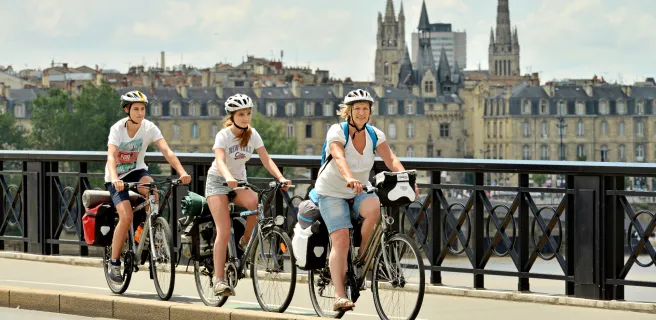
The vine-covered limestone plateau between the Garonne and Dordogne Rivers east of Bordeaux is known as l’Entre-deux-Mers, the area ‘between the two seas’! The Roger Lapébie Greenway takes you amidst vineyards, via the east bank of the Garonne, to the great wine city. Cross the Pont de Pierre, the town’s oldest bridge, for the historic quarters of St-Michel and St-Jean. Bordeaux is a great place to explore by bike before continuing on the Scandibérique. This beautifully modernized town merits a cultural break of several days. Once you’ve admired your reflection, together with that of this handsome city, in the mirrored pool beside the quays one last time, it’s time to head south for the landscapes of Gascony’s Landes, including the largest man-made forest in Western Europe.
Afficher les étapes