15 stages · 510 km

Gradients and elevation

Ascents: 1172m
Descents: 1199m
Lowest point: 0m
Highest point: 144m

Road types

314km (62%) By road
194km (38%) Cycle path
142km (31%) Provisional itinerary
2km (2%) Unknown

Surface

50km (165%) Smooth
11km (35%) Rough

15 stages used

Paris / Chatou

1 Paris / Chatou

30 km
2 h 01 min
I cycle often
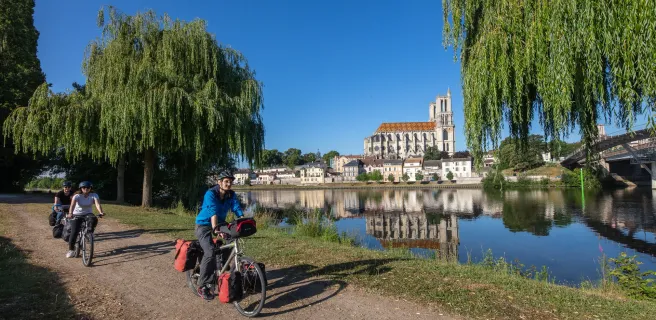
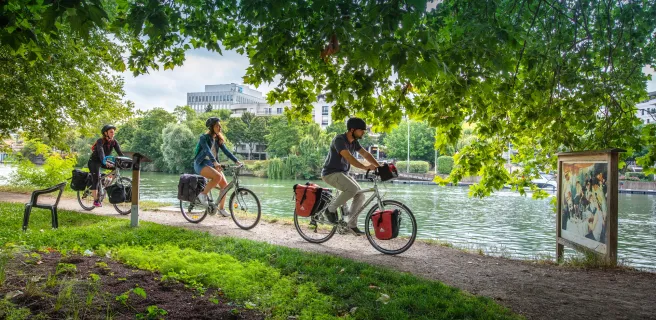
The square in front of Paris’s Notre-Dame Cathedral counts as kilometre-zero in France; it’s where the Seine à Vélo cycle route officially begins. The way first leads you peacefully north out of the capital via the Canal Saint-Martin and its iconic, trendy quarter, offering a cliché of romantic Paris, before you branch off along the Canal Saint-Denis, with its startling Street Art Avenue outdoor art. Notre-Dame’s great sister church, the Basilica-Cathedral of Saint-Denis, holds the tombs of France’s royals. The route continues to Gennevilliers, a major river port for the Ile-de-France Region (around Paris), joining the Seine and its c.10km-long Promenade Bleue, using the river’s former towpaths. The Seine-side landscapes, partly industrial, partly rustic, inspired great Impressionist artists. Pause on the Ile des Impressionnistes at Chatou, at the terrace where Renoir painted Le Déjeuner des Canotiers, or at the iconic restaurant terrace of Les Rives de la Courtille, or then at the Hameau Fournaise. This first stage ends on the border between the counties of Hauts-de-Seine and Yvelines.
Chatou / Conflans-Sainte-Honorine

2 Chatou / Conflans-Sainte-Honorine

25 km
1 h 41 min
I cycle often
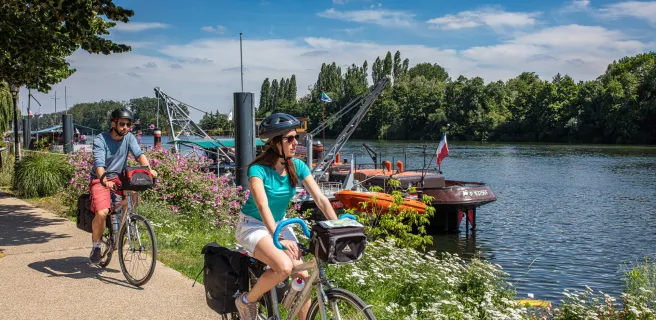
This Seine à Vélo stage transports you back from the Impressionist period to the times when boatmen and mariners ruled these parts. Do explore the Saint Germain Boucles de Seine area, plunging into French royal and imperial history, Impressionist painting and the imaginary worlds of writer Dumas and composer Debussy… The State forests of Saint-Germain and Marly-le-Roi serve as green lungs for Paris’s western suburbs. Pushing further west, tucked between the Seine and its valley’s slopes, the route leads to La Frette-sur-Seine, nicknamed ‘the pearl of the county of Val d’Oise’. The cycle path runs along its quays, lined with splendid 19th-century villas, with outdoor copies of paintings on display by the likes of Pissarro, Marquet and Daubigny, immortalizing the Seine here.
Finally, you reach Conflans-Sainte-Honorine, capital of traditional Seine navigation in these parts, offering an intense taste of the French art of living.

Conflans-Sainte-Honorine / Mantes-la-Jolie

3 Conflans-Sainte-Honorine / Mantes-la-Jolie

47 km
3 h 10 min
I cycle often
The Seine à Vélo leaves behind the old Seine boatmen’s capital, heading for Mantes-la-Jolie, with its impressive riverside collegiate church. Nature begins to make its presence felt as you cycle west along the Seine’s meanders, past islands. Make a short detour to Poissy, a town with a rich architectural heritage, influences going from 13th-century French king St Louis to modernist architect Le Corbusier and his Villa Savoye. Next, don’t miss the Parc du Peuple de l’Herbe, with 113 hectares of nature to discover. Continue to the Ile de Loisirs du Val de Seine at Verneuil-sur-Seine. This Leisure Island provides an ideal stop for relaxing by the water, enjoying many outdoor activities, including, in warmer weather, swimming.
Gradually, the urban atmosphere gives way to the rural, and to bucolic landscapes. The Vexin area now welcomes you…
Mantes-la-Jolie / La Roche-Guyon

4 Mantes-la-Jolie / La Roche-Guyon

26 km
1 h 47 min
I cycle often
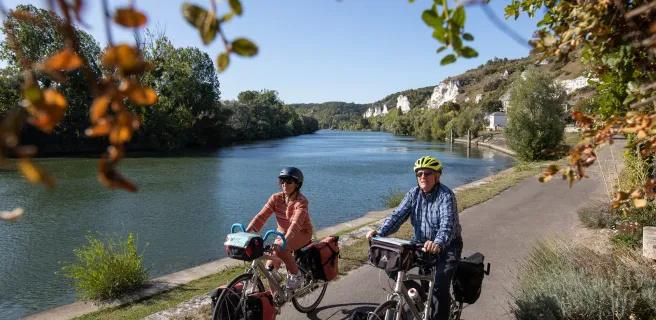
Leaving Mantes-la-Jolie, this provisional stage of the Seine à Vélo continues along the north bank of the river. The track leads around the Guernes Meander, once known for its cherry orchards. The song of migrating, nesting or wintering birds accompanies you as you pass the lakes at Flicourt, while at Port Ilon, boats find refuge from the river. In the hollow of another meander, Vétheuil appears, with its old winemakers’ houses laid out in tiers up the slope. Don’t miss the village church’s Renaissance façade and Claude Monet’s riverside house here. The chalk heights of Les Coteaux de la Seine Nature Reserve accompany you up to Haute-Isle, with its startling troglodytic church. Next, make for La Roche-Guyon, the only member of the association Les Plus Beaux Villages de France in the Ile-de-France Region surrounding Paris. Rising above its château, the keep looks like a lighthouse rising above the chalk cliffs. The French-style kitchen garden also makes quite an impression.
La Roche-Guyon / Vernon

5 La Roche-Guyon / Vernon

19 km
1 h 14 min
I cycle often
Sticking by the river, on this Seine à Vélo stage, follow in the footsteps of the great painter Claude Monet. Take a last look back at the Château de La Roche-Guyon and the charming village around it before heading off on Monet’s trail. This bucolic waterside stage incites contemplation. You leave the Ile de France Region for Normandy and the département (county) of Eure, heading for Giverny, then Vernon, with wonderful discoveries to make, not just from the Impressionist period, but also from medieval times. In Giverny, a tour of Claude Monet’s house and of the art museum, the Musée des Impressionnismes, are a must. Vernon’s museum also contains fine Impressionist works, including two original Claude Monet canvases. Along this stage, try the excellent local produce on offer, from the Château de la Roche-Guyon’s kitchen garden to the Vergers de Giverny orchards.
Vernon / Les Andelys

6 Vernon / Les Andelys

26 km
1 h 42 min
I cycle often
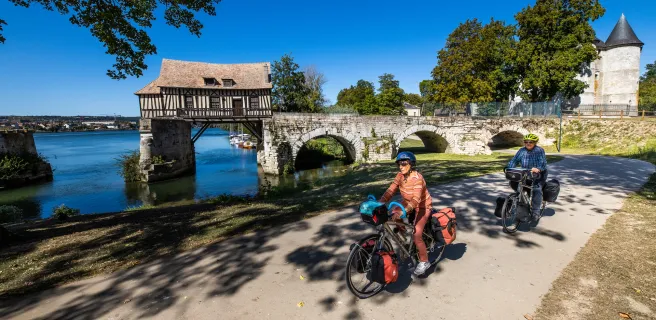
Leaving Vernon, its Seine-side quays and the Vieux Moulin, a picturesque watermill, echoes of Impressionist settings and colours are still easy to pick up. Continue west along the Seine towpaths, once vital to commercial trading along the river. Passing lakes and sand-extracting works, you also encounter medieval Norman history, in the form of the mighty Château-Gaillard, dominating the town of Les Andelys since the 12th century.
Les Andelys / Poses

7 Les Andelys / Poses

31 km
1 h 58 min
I cycle often
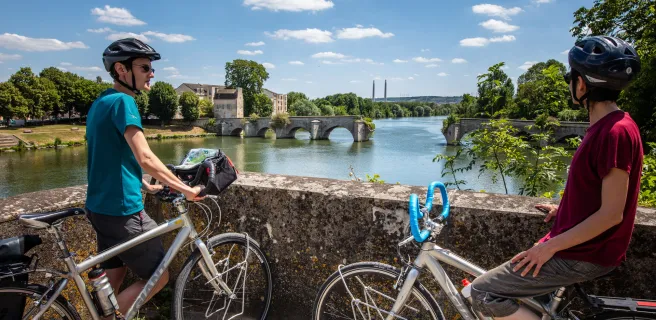
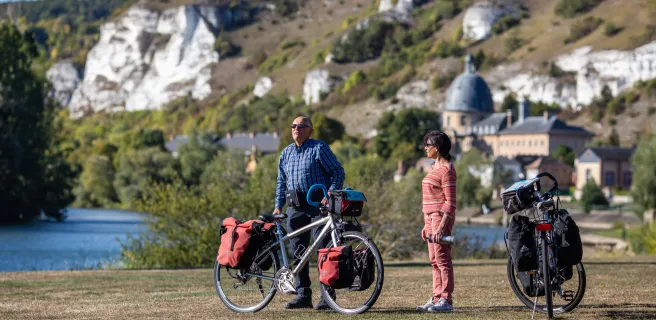
Leaving Les Andelys, admire the magnificent cliffs rising above the Seine. The river’s winding meanders lead you to the small village of Poses, once a centre for Seine mariners, its towpath in an idyllic setting. Learn about the river boatmen’s life and life along the river via the two boats-cum-museums recounting this story, via mariners’ graffiti on the church walls, and via the dam here, with its Seinoscope, allowing you to view fish passing through. One meander follows another, with islands in the stream, the settings unspoilt. To relax at the end of your day, enjoy a refreshing visit to the outdoor leisure activities centre at Léry-Poses, based around lakes right beside the Seine, and to Biotropica, an animal park next door.
Poses / Rouen

8 Poses / Rouen

45 km
3 h 02 min
I cycle often
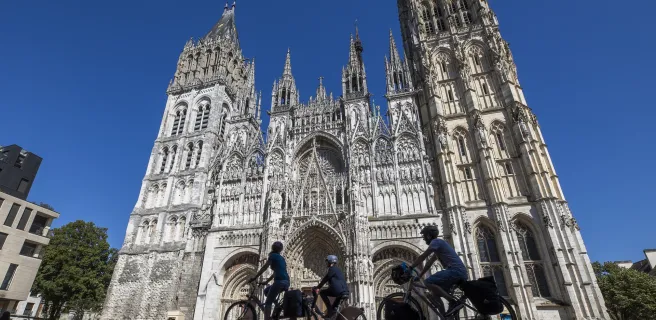
This stage takes you up to Rouen, nicknamed ‘the town of a hundred bell towers’. Passing first through the medieval heart of Pont-de-l’Arche, pause to appreciate its pretty location, where the rivers Eure and Seine meet. Also, don’t miss Notre Dame de Bonport Abbey, founded by Richard the Lionheart. Further west, Elbeuf, a former cloth-manufacturing town, has a free exhibition covering its rich industrial past, at La Fabrique des Savoirs. As to the Cirque Théâtre, one of just eight permanent circus buildings left standing in France, it’s also worth a tour. Back on the Seine’s towpath, impressive chalk cliffs carved out far back in time oversee your progress. Get up close to them by visiting the semi-troglodytic church at Orival. Then the surprising Forest of La Londe Rouvray offers you a green path into Rouen. This bustling city is crammed full of history; exploring its finely restored medieval heart proves a delight.
Rouen / La Bouille

9 Rouen / La Bouille

20 km
1 h 18 min
I begin
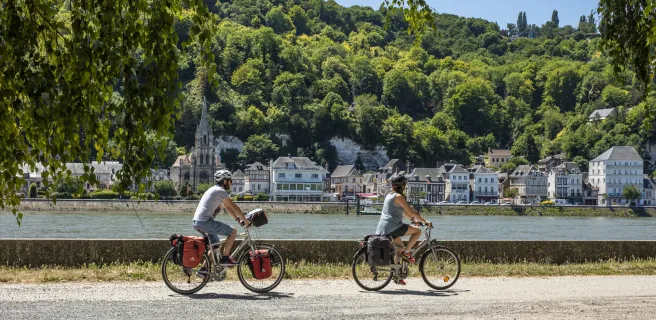
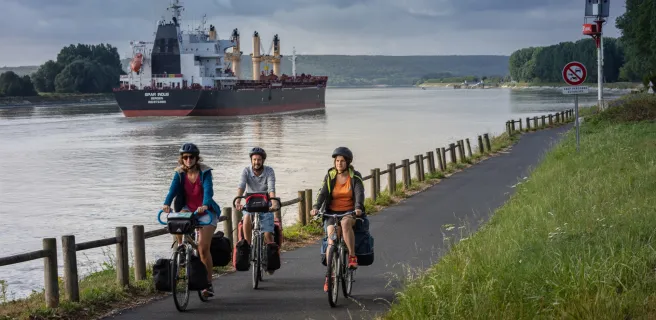
Leaving the bell towers of Normandy’s capital behind, cranes take over the skyline, signalling Europe’s largest port for the exporting of cereals. Enormous cargo vessels, some almost 300m in length, load up here. Gradually, heading west, the atmosphere changes, as typical Norman villages with old sandstone and timber-frame houses follow. You arrive in the heart of the Parc Naturel Régional des Boucles de la Seine Normande, where the relaxing feel is added to by the slow coming and going of vessels. Before boarding the ferry across the Seine to reach La Bouille, stop to see the gardens at the Château de Soquence, with a beautiful viewpoint over the river. On the other bank, you can spot the Château de Robert le Diable, historic guardian of this Seine meander. La Bouille, birthplace of 19th-century writer Hector Malot, proved a source of inspiration for Impressionist painters and makes a lovely place to stop.
La Bouille / Jumièges

10 La Bouille / Jumièges

35 km
2 h 19 min
I cycle often
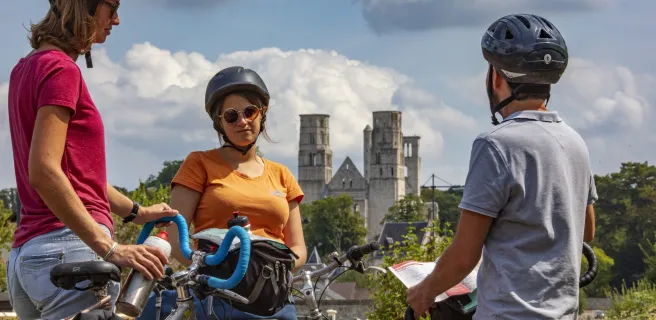
The Seine à Vélo cycle route leaves a spot so special to the Impressionists to follow the Route des Fruits, or Fruit Route. As well as admiring apple, pear, plum and cherry orchards, bearing fruit in different months, make the most of a trip into the heart of the Parc Naturel Régional des Boucles de la Seine Normande to visit local producers. Foodies might plan a special stop in the riverside town of Duclair, to taste its traditional speciality, pressed duck. If keen on history, visit the Château du Taillis, its museum dedicated to the war in Normandy in August 1944. End this stage in style, taking your bike on the ferry over to Yville-sur-Seine to reach the village of Jumièges, dominated by one of Normandy’s most remarkable medieval Benedictine abbeys. Victor Hugo described it as ‘France’s most beautiful ruin’. In this contemplative spot, enjoy a reflective pause before embarking on the last stages of the route, either heading to Le Havre along the north bank of the Seine Estuary, or to Honfleur and Deauville along the south bank.
Jumièges / Lillebonne

11 Jumièges / Lillebonne

45 km
2 h 58 min
I cycle often
With this stage, leave behind Jumièges and ‘the most beautiful ruin in France’, as Victor Hugo described its abbey, to continue west along the Seine à Vélo via a former rail line, now a greenway, connecting Caudebec-en-Caux to Barentin. Arriving at Caudebec-en-Caux, make the most of the calm of the Seine’s banks, following in the footsteps of Victor Hugo. Reaching Villequier, where the Hugo and Vacquerie families holidayed, this charming village makes a perfect place to pause and find out more about the great author’s writings. This stage’s last stretch leads to Lillebonne. This town has an older, Roman name, Juliabona, hence the remnants of a Roman theatre, plus a museum covering the history of the Gallo-Roman settlement here.
Lillebonne / Le Havre

12 Lillebonne / Le Havre

42 km
2 h 33 min
I cycle often
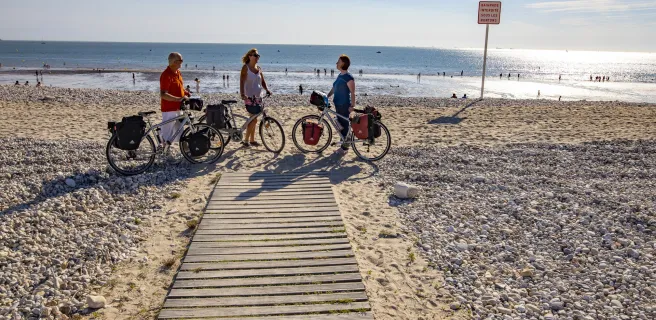
Riding beside the Seine for its final kilometres, see how the mighty river grows much wider. The port of Le Havre and the département (county) of Calvados are now just a short ride away. This last stage of the Seine à Vélo takes you under the impressive Tancarville Bridge. Pause to admire this architectural wonder, suspended 123 metres above you. Completed in 1959, it was the first great bridge built to span the Seine between Rouen and Le Havre. The greenway runs beside the canal parallel to the Seine, with views of fields, industry and cliffs. In the distance rises the Pont de Normandie. Nearing the end of the route, the historic heart of Harfleur, with its medieval houses, is worth exploring before entering Le Havre. This port’s centre, destroyed in World War II, was rebuilt according to the plans of architect Auguste Perret. The place has been declared a UNESCO World Heritage Site in recent times. Arriving at Le Havre’s pebble beach, you might take a well-deserved dip in the sea, or enjoy wandering along the seafront.
Jumièges / Marais-Vernier

13 Jumièges / Marais-Vernier

46 km
2 h 51 min
I cycle a lot
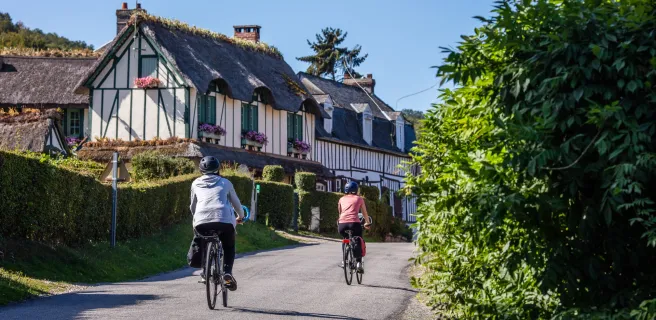
This Seine à Vélo stage takes you meandering through the typical Norman scenery of the Brotonne Forest and Vernier Marsh. First, cross the Seine by ferry at Jumièges. Then the route leads you along the river’s south bank, offering the finest views over the Seine. Arriving at Aizier, La Route des Chaumières (or Thatched Cottages Route) takes you to the edge of the Marais-Vernier, a precious natural site, its unique ecosystem extending across 4,500 hectares. You cross undulating landscapes providing a mix of natural riches, traditional Norman architecture and some startling encounters, in the form of storks and Camargue white horses. Along the way, make time to stop at the Maison du Parc Naturel des Boucles de la Seine Normande, a visitor centre that explains all about these parts and the flora and fauna here.
Marais-Vernier / Honfleur

14 Marais-Vernier / Honfleur

26 km
1 h 44 min
I cycle a lot
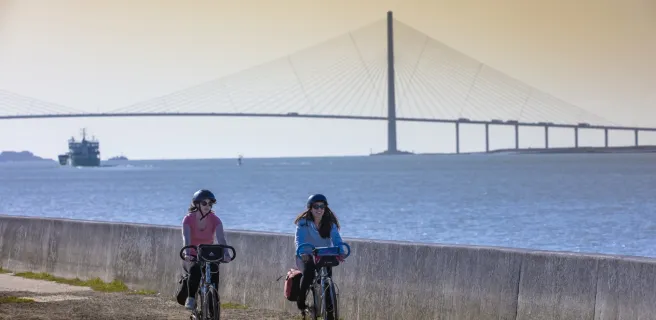
As the Seine à Vélo route leaves behind the extensive wetlands of the Marais-Vernier and their marvels, continue riding through tranquil Norman countryside up to the Seine’s banks and the charming village of Berville-sur-Mer. The route takes you right through the heart of this old fishing port. Stop at its esplanade to admire the splendid view across to two bridges, the Pont de Tancarville and the Pont de Normandie, rising magnificently above the Seine. Back on your bike, you draw closer to the latter. As to the enchanting port of Honfleur, it hides just behind it. Explore the harbour’s utterly picturesque streets, enjoying a well-deserved stop here. The place drew numerous Impressionist painters, intent on immortalizing this Norman gem.
Honfleur / Deauville

15 Honfleur / Deauville

48 km
3 h 06 min
I cycle a lot
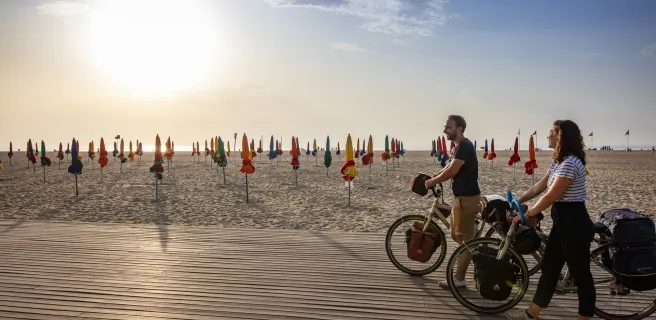
Enjoy a last look back at the historic port of Honfleur, a cradle for early Impressionists, before the Seine à Vélo leads you into the beautiful verdant meadows of the Pays d’Auge area. The finest race horses are trained here, while the grazing cows produce some of Normandy’s finest cheeses. The route takes you to Pont-l’Évêque, the name of the town also carried by an excellent local cheese. Foodies will enjoy trying local Calvados apple brandy too. Rows of apple trees line the way to Deauville’s great beach, like fans encouraging you in your final effort to reach the line at the end of the cycle route! So you arrive at the seaside and broad sands decorated with colourful parasols. Leave your bike to one side to enjoy the reward of a swim and a good rest. Just across the Dives Estuary stands the historic port of Trouville, a tempting place to taste an array of seafood by the fish market.
Afficher les étapes