9 stages · 391 km

Gradients and elevation

Ascents: 920m
Descents: 874m
Lowest point: 132m
Highest point: 345m

Road types

288km (74%) Cycle path
104km (26%) By road

Surface

127km (163%) Smooth
4km (5%) Unknown
25km (31%) Rough

9 stages used

Sarreguemines / Gondrexange

1 Sarreguemines / Gondrexange

78 km
5 h 11 min
I begin
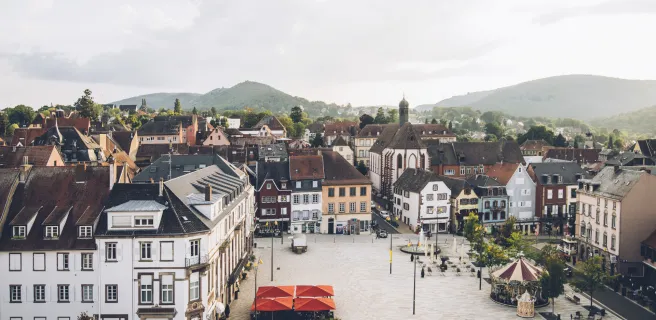
The EuroVelo 5 cycle route leaves Germany at Sarrebruck, entering northeast France. It follows the canalized Sarre, which serves for a time as the border between the two countries. The EV5 arrives at Sarreguemines, a pretty town renowned for its ceramics, then continues along the Sarre Canal. At Sarralbe, the Church of St Martin is known as ‘the cathedral of the Sarre’ for its soaring twin Gothic spires. The town formed part of the Ligne Maginot Aquatique, a water-based defence system. In the Alsace Bossue area, at Harskirchen, discover the unspoilt landscapes of the alluvial plain here, La Honau classified a Natura 2000 Site, home to special flora and fauna. The route crosses woods and beside
lakes (notably Le Stock and Gondrexange), taking you through an exceptional environment.
Gondrexange / Saverne

2 Gondrexange / Saverne

42 km
2 h 55 min
I begin
At the junction with the V52 heading towards Nancy, EuroVelo 5 leaves the Sarre Canal and follows the towpath beside the Canal de la Marne au Rhin towards Sarrebourg. This town is known for its Chagall Trail, leading visitors from the Chapelle des Cordeliers, where the artist’s stained-glass window entitled ‘Peace’ radiates colour, to the museum where the tapestry of the same name is displayed. The cycle route continues through the Vallée des Eclusiers (Lock-keepers’ Valley), closed to navigation since 1969, the year when the extraordinary Plan Incliné de Saint-Louis Arzviller boat-lift opened. Today, the Vallée des Eclusiers is bucolic, shared by cycling tourists, walkers, anglers, climbers and people passionate about nature and heritage. Lutzelbourg, with its 11th-century château on a promontory, is the last stop on the EV5 in French Moselle before Alsace.
Saverne / Strasbourg

3 Saverne / Strasbourg

48 km
3 h 09 min
I begin
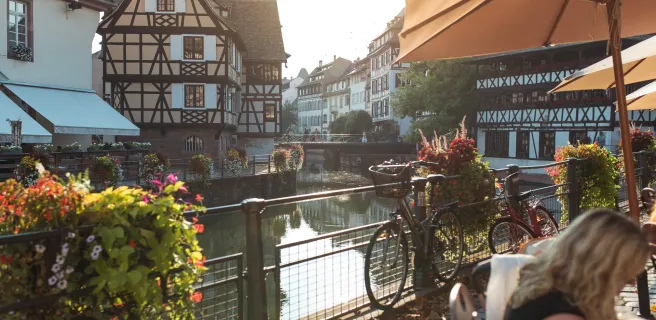
Leaving Saverne, a town known as the ‘Cité des Roses’ and boasting the magnificent Château des Rohan, EuroVelo 5 joins the Véloroute du Canal de la Marne au Rhin, taking you peacefully along the Zorn Valley to the outskirts of Strasbourg. Along the way, enjoy the open landscapes of the Alsace Plain and stop at the Villa Météor at Hochfelden for a beer-themed halt. Strasbourg claims to be France’s leading cycling city and makes for an unmissable stop. Take time to wander around the historic centre, especially the quarter known as Petite France and the stunningly decorated cathedral. You can’t leave without (re-)tasting Alsace’s famous culinary specialities.
Strasbourg / Soultz-les-Bains

4 Strasbourg / Soultz-les-Bains

24 km
1 h 38 min
I begin
After an unmissable stop in Strasbourg, one of the capitals of the European Union, with its enchanting streets and stunning cathedral, leave the city via the banks of the Ill River and the Canal de la Bruche. Designed by Louis XIV’s engineering genius, Vauban, to transport sandstone blocks from the Vosges Range to Strasbourg, this old canal acts as a guiding thread, taking you through a bucolic natural setting. The way links Strasbourg to Alsace’s Route des Vins (Wine Route) and is a favourite weekend outing for Strasbourg’s inhabitants.
Soultz-les-Bains / Châtenois

5 Soultz-les-Bains / Châtenois

49 km
3 h 18 min
I cycle often
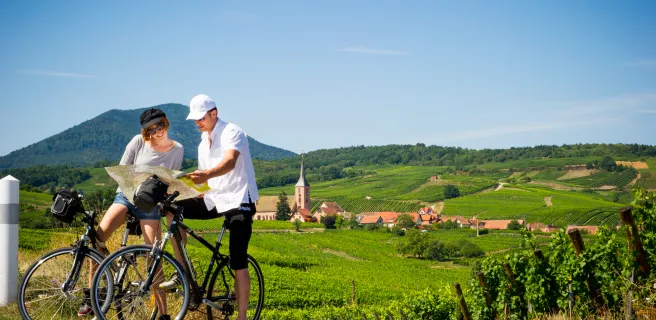
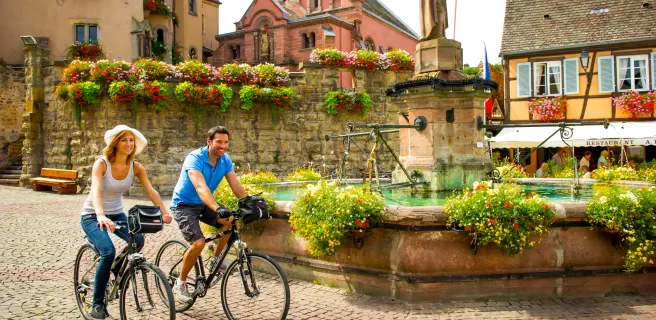
La Route des Vins d'Alsace (or Alsace Wine Route) wends its way along the eastern slopes of the Vosges Mountains. Running parallel to it, the Véloroute du Vignoble d'Alsace (or Alsace Vineyards Cycle Route), crosses picture-postcard landscapes, with ruined castles, flowery villages, Romanesque abbeys, orchards, and a sea of vines. The northern part of the cycle route starts at Marlenheim and goes up to Châtenois, passing via Molsheim, Rosheim, Obernai, Barr and Dambach-la-Ville, under the protective gaze of the Mont Sainte-Odile and the Château du Haut-Koenigsbourg.
Châtenois / Turckheim

6 Châtenois / Turckheim

27 km
1 h 56 min
I begin
After Châtenois, the Véloroute du Vignoble d'Alsace follows the historic Roman way that ran along the bottom of the Vosges’s foothills, providing panoramic views over the sea of vines beyond. Typical wine-producing villages follow in quick succession, a short spin on your bike allowing you to reach prestigious viticultural stops such as Ribeauvillé, Riquewihr or Kaysersberg, while the great town of Colmar, with its utterly picturesque Petite Venise Quarter, lies not far off.
Turckheim / Cernay

7 Turckheim / Cernay

51 km
3 h 25 min
I cycle often
The southern half of the Véloroute du Vignoble d'Alsace is wilder, providing beautiful views of vine-covered slopes and up to the Ballons d'Alsace, the highest summits of the Haut-Vosges Mountains. There are several unmissable stops, such as Eguisheim, Alsace’s famed circular village and a member of the association of Les Plus Beaux Villages de France, or Guebwiller, winning awards for its floral displays and declared a Territoire Vélo by the French Cycling Federation. Cernay and Thann are the final places to visit along the Route des Vins d'Alsace, below the protective gaze of Le Vieil Armand, with its national First World War monument atop a spectacular rocky outcrop.
Cernay / Mulhouse

8 Cernay / Mulhouse

35 km
2 h 23 min
I cycle often
The EuroVelo 5 route leaves behind the Véloroute du Vignoble d'Alsace and the vine-covered slopes to cross the Alsace Plain and its potassium basin for the town of Mulhouse. Close to the well-flowered town of Ensisheim, Ungersheim boasts two unmissable sites: the Ecomusée d'Alsace and the Parc du Petit Prince, a delight for young and old. As to Mulhouse, combining tradition and modernity, it has major museums linked to its industries, hence its nickname of ‘European capital of technological museums’! The town has also been designated a Territoire Vélo, given provisions for cyclists.
Mulhouse / Bâle

9 Mulhouse / Bâle

38 km
2 h 57 min
I begin
Mulhouse, designated a Ville d’Art et d’Histoire for its rich industrial past, is known as ‘the French Manchester’. It boasts exceptional museums, including the famed Cité de l'Automobile and Cité du Train. Heading south, the EuroVelo 5 route leads into the Pays de Saint-Louis, an area where three countries meet – France, Germany and Switzerland. Along the way, there are several points of interest, such as Alsace’s Petite Camargue, the Fondation Fernet-Branca and the Parc des Eaux Vives. At Huningue, the footbridge named the Passerelle des Trois Pays marks the end of your cycling adventure through Alsace. Switzerland and the lively town of Basel lie ahead!
Afficher les étapes