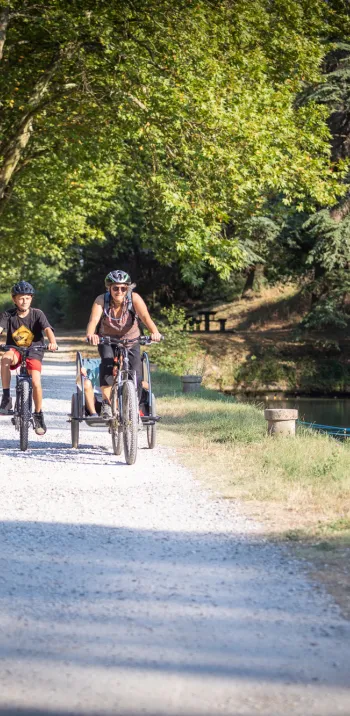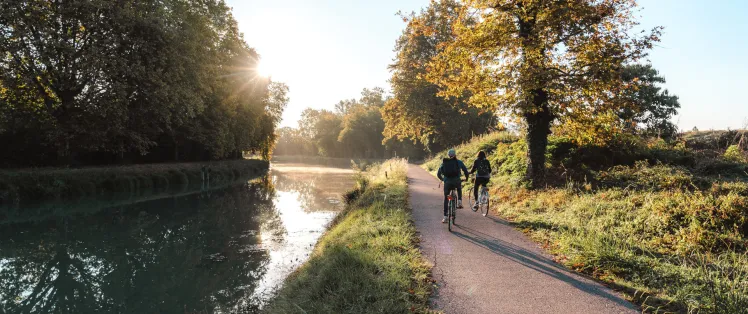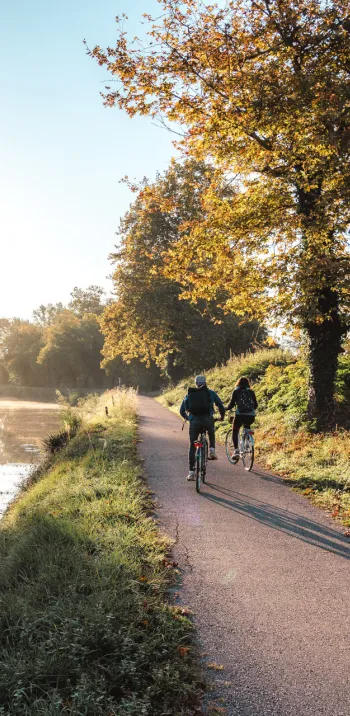
La Véloccitanie et les vignes héraultaises
Sedat Yagiz

Boucle entre Canal du Midi et Haut-Languedoc

Grande boucle à vélo de 390 km depuis Béziers

Explorez l'Occitanie à vélo sous ses plus beaux atours, d'une véloroute à une autre : après une échappée sur le Canal du Midi, rythmé par ses ouvrages d'art, sinuez le long de la Rigole de la Plaine, puis pédalez sur PassaPaïs, ancienne voie ferrée à flanc de montagne, avant de découvrir les vignobles du Languedoc.

  • Départ : Béziers, Carcassonne
  • Distance : 390 kilomètres
  • Balisage :
La Véloccitanie et les 9 écluses de Fonséranes
Sedat Yagiz

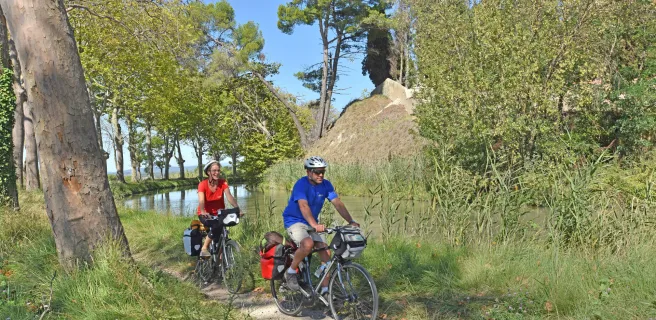
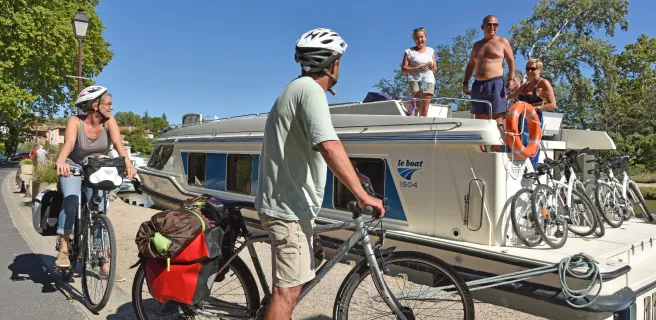
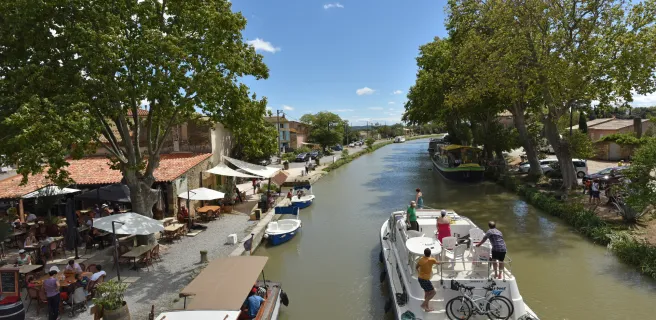
Le long du Canal du Midi, entre écluses et guinguettes

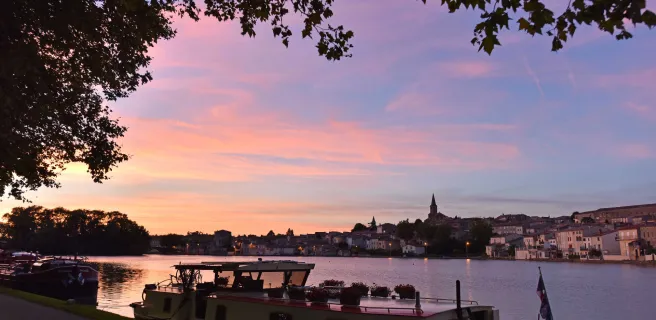
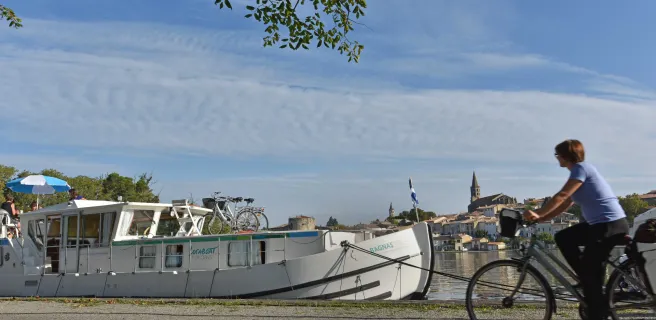
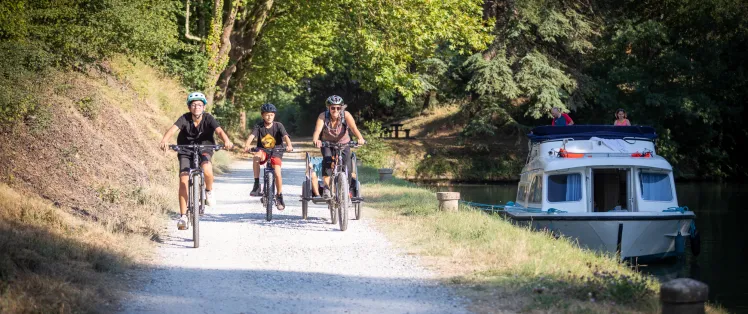
Plongez dans la longue et mythique histoire du Canal du Midi datant du XVIIè siècle. Vous pédalerez au rythme d'innombrables écluses, des petits villages au bord de l'eau et leurs guinguettes, au fil des platanes...

La Rigole de la Plaineri
La Véloccitanie - Sedat Yagiz

La Rigole de la Plaine

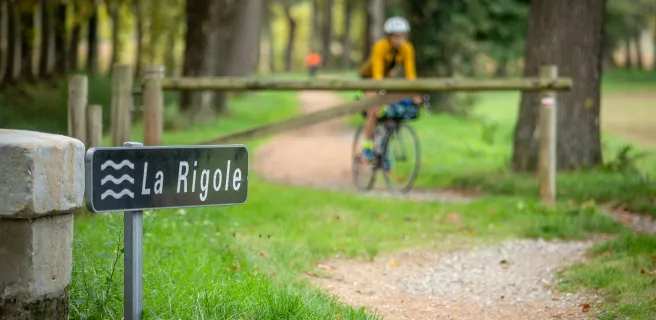
Explorez les origines du canal du Midi à vélo, en suivant les traces de Pierre-Paul Riquet. Admirez les ouvrages hydrauliques historiques qui jalonnent ce parcours de 50 kilomètres. Profitez des ombrages des platanes et des points de vue sur le Lauragais, tout en découvrant l'ingéniosité de Riquet et le génie hydraulique de l'époque. Des haltes rafraîchissantes sont disponibles le long de la Rigole de la Plaine.

Olargues sur la Véloccitanie
La Véloccitanie - Sedat Yagiz

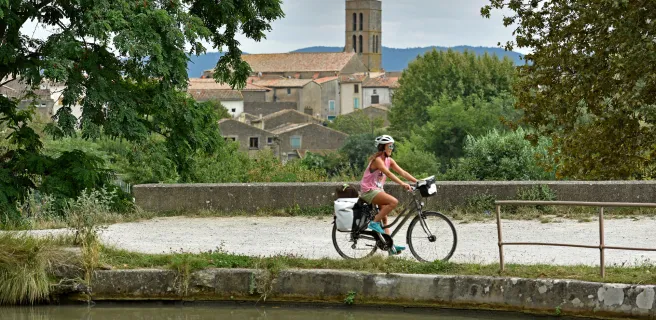
Villages médiévaux, cités de caractères ...

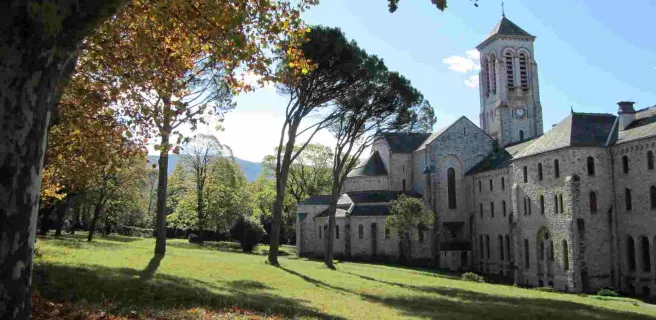
Visitez Mazamet, berceau du textile du 19ème siècle, et Hautpoul via une passerelle saisissante. Olargues, avec son Pont du Diable et ses ruelles médiévales, offre un riche patrimoine. Découvrez Lamalou-les-Bains, ville Belle Époque célèbre pour sa source thermale, son architecture remarquable et son casino historique.

Voie Verte à vélo "PassaPaïs"
ADT 34 - E. Brendle

Voie Verte à vélo "PassaPaïs"

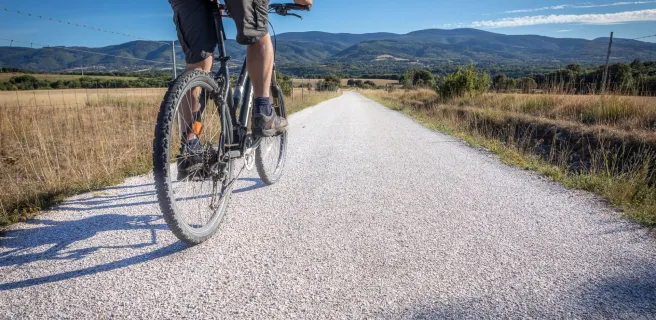
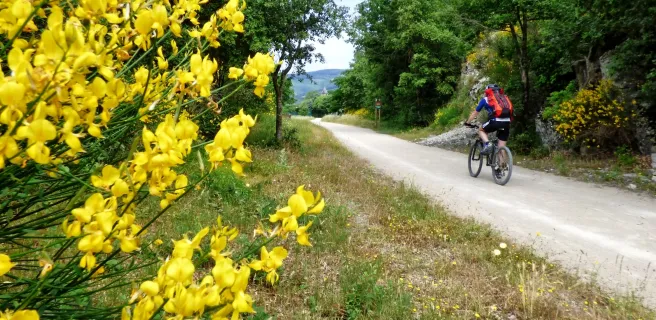
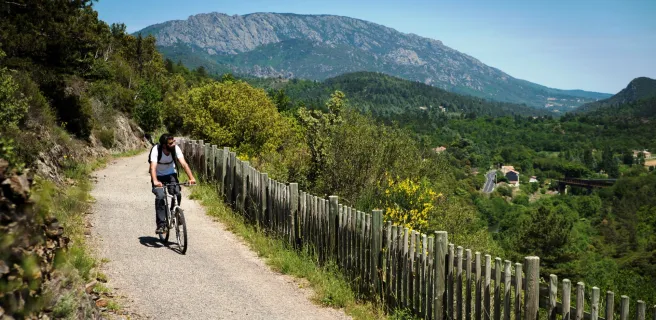
Pédalez au cœur du Parc naturel régional du Haut-Languedoc sur une une ancienne voie ferrée : un parcours sécurisé en pleine nature idéal pour débuter, entouré de moyennes montagnes, forêts et garrigues.

Vignes sur l'itinéraire de La Véloccitanie
La Véloccitanie - Sedat Yagiz

Au coeur des vignes

Explorez un territoire au riche patrimoine et vignobles célèbres. Paysages enchanteurs, murets en pierre sèche, et vestiges historiques vous attendent. Découvrez les ruines anciennes à l'Oppidum d'Ensérune et l'étang de Montady, étoilé et asséché. Admirez le génie de Pierre-Paul Riquet avec le Tunnel du Malpas et les neuf écluses de Fonseranes. Terminez à Béziers, entre bâtisses bourgeoises, la cathédrale Saint-Nazaire, et le fameux chameau de Béziers.

Tailor-made itineraries

Tailor-made itineraries

Capestang / Béziers

27 Capestang / Béziers

21 km
1 h 19 min
I cycle often
This stage is packed with surprises. The 17th-century Tunnel de Malpas draws the attention, built as Europe’s first-ever navigable canal tunnel. On the hill above, visit the impressive vestiges of a pre-Roman, Celtic settlement, the Oppidum d’Ensérune. From here, look down on the amazing pattern of the dried-out circular lake of Montady, originally dug by medieval monks. Then admire the extraordinary nine locks of Fonsérannes and the splendid canal-bridge over the Orb River with magnificent views up to historic Béziers.
Le Somail / Capestang

26 Le Somail / Capestang

23 km
1 h 31 min
I cycle often
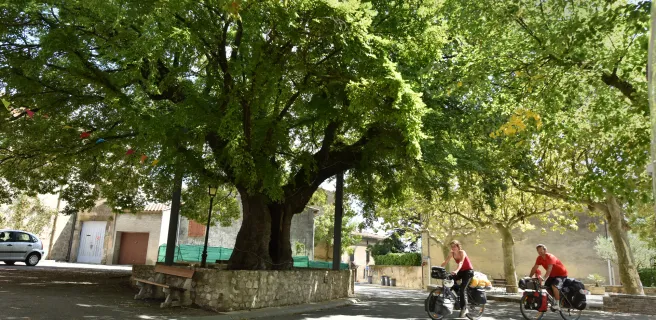
It’s a wrench leaving enchanting Le Somail. Although the port of Sète is a long way off, this is just a short stage to Capestang, signalled by the bell tower of St-Félix Church, which guides you to this village’s central square, where you can enjoy a rest in the shade of the plane trees.
The Canal du Midi by bike : Homps / Le Somail
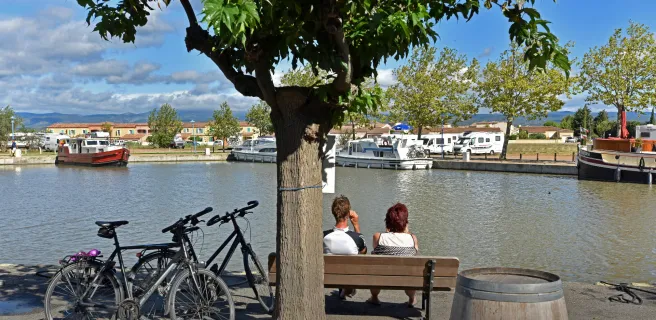
23 The Canal du Midi by bike : Homps / Le Somail

20 km
1 h 19 min
I cycle often
A string of wine-making villages, Argens-Minervois, Roubia, Paraza and Ventenac-en-Minervois, congregate here beside the Canal du Midi, calling for your attention! Le Somail’s port was where the canal’s designer, Pierre-Paul Riquet, calculated that the post barge should stop for the couchée, or sunset, on the third day of its trip from Toulouse. Now, Le Somail is one of the canal’s most attractive stops, a picture-postcard village with its port, chapel, canal-side accommodation and amazing antiquarian bookshop.
Marseillette / Homps

22 Marseillette / Homps

18 km
1 h 13 min
I cycle often
This stage is dotted with admirable technical feats, in particular the astonishing hydraulic overflow facility designed for the Canal du Midi at La Redorte by the great 17th-century engineer Vauban. Homps, an historic wine-exporting port, is very lively, with many shops, and a bit of a shock after the sleepy atmosphere along much of the canal. Here you find yourself in the heart of the Minervois area. Close to Homps, Jouarres Lake offers you the possibility of going bathing.
Carcassonne / Marseillette

21 Carcassonne / Marseillette

22 km
1 h 28 min
I cycle often
Not one, but two bridge-aqueducts were needed to cross the Fresquel and Orbiel Rivers to reach Trèbes, with its lively port, its canal-side cafés-restaurants and its church of St-Etienne, in the heart of the historic village. The Minervois area and its reputed vineyards lie just a short cycle ride away from the Canal du Midi here.
Bram / Carcassonne

20 Bram / Carcassonne

24 km
1 h 36 min
I cycle often
From Bram to Carcassonne, the route runs alongside the Canal du Midi, which is in no rush, so take your time to linger over this beautiful stage. You come to the port in the lower town of Carcassonne, built originally as a fortified medieval grid-plan bastide. Above, Carcassonne’s mighty medieval citadel atop its hill dominates the surrounding countryside. Listed as a UNESCO World Heritage Site since 1997, the citadel encourages many cyclists to make a significant halt on the route here.
Castelnaudary / Bram

19 Castelnaudary / Bram

17 km
1 h 06 min
I cycle often
Leaving Castelnaudary, you pass the imposing St-Roch lock with its four interconnecting chambers. Further on, at the level of Bram’s port and the canal-side restaurant, l’Ile aux Oiseaux, a cycle track allows you to make a short detour into the centre of Bram, a town which stands out for its silhouette and its circular medieval centre, known as a ‘circulade’, a form typical of the Aude.
Seuil de Naurouze / Castelnaudary

18 Seuil de Naurouze / Castelnaudary

13 km
49 min
I cycle often
Going from lock to lock, the canal’s towpath leads you through the heart of the Lauragais area. Le Seuil de Naurouze, at the watershed dividing the waters flowing to the Atlantic from those flowing to the Mediterranean, is a key point on the Canal du Midi, supplied by the Rigole de la Plaine channel coming down from St-Ferréol Lake. The canal continues to the town of Castelnaudary, capital of famed cassoulet bean and meat stew, but also boasting the largest canal basin on the Canal du Midi.
Seuil de Naurouze / Revel

1 Seuil de Naurouze / Revel

38 km
2 h 22 min
I begin
Follow in the footsteps of great 17th-century French engineer Pierre-Paul Riquet, who designed the Canal du Midi, and travel back in time to the canal’s beginnings as you ride along this stage! Discover the countless extraordinary hydraulic works built during Riquet’s lifetime to channel waters coming down off the mighty Montagne Noire to bring to life the Canal du Midi. Witness Riquet’s scientific rigour and invention, admiring the scale of the project and the skills of the workers involved. Across 50km, an extraordinary story of engineering prowess unfolds. Shade was even planned, rows of splendid canal-side plane trees thoughtfully planted for the benefit of future generations! Enjoy a pause to cool off beside the reservoirs dotted along the Rigole de la Plaine (a channel specially created to feed the Canal du Midi with water), taking in splendid views over the patchwork of fields and the perched villages of the Lauragais area. Savour all these little delights along this historic watery route.
Revel / Castres

2 Revel / Castres

32 km
1 h 55 min
I cycle often
Ride across the Lauragais’s plains from Revel to Castres, through an area recognized for its arts heritage and nicknamed the Pays de Cocagne (Land of Milk and Honey in French, the term also referring specifically to the lucrative cocagne shells of woad produced here and used in once highly-prized pastel blue dyeing). The fields are covered in sunflowers, wheat and poppies in early summer. You’re crossing the cereal-growing part of La Véloccitanie. Its mosaic of colours is reflected in Dom Robert’s tapestries at the abbey-school in Sorèze, in the painted galleries around the medieval covered market in the bastide town of Revel (hosting one of France’s finest markets) and in the colourful facades at Castres, a town nicknamed the Little Venice of the Haut-Languedoc. This last also boasts fine arts in its Musée Goya. The Montagne Noire, a major mountain on the horizon, its waters feeding the Canal du Midi, acts as a guiding presence as you ride along undulating little country roads peppered with villages. Enjoy the odd stop to rest and admire the landscapes and taste local dishes. Savour these moments and the colourful delights provided by this stage’s mix of agriculture and culture.
Castres / Mazamet

3 Castres / Mazamet

22 km
1 h 22 min
I cycle often
With the Montagne Noire as backdrop, ride from Castres to Mazamet alongside rivers and crossing a typical, rocky weathered limestone plain, or causse, spotting through the foliage along the way some sumptuous typical regional buildings. These read like so many pages in the area’s book of history. The towns around here made the most of natural features to develop, exploiting water for wool, leather, textiles and dyeing, the wide-open fields for agriculture, the forests for raw materials and the steep mountain sides for refuge. Leaving Castres, a first surprising site awaits you, in the form of the Causse de Caucalières et Labruguière, a semi-deserted limestone plateau. With its unusual geology and striking natural environment, this area is home to certain rare bat and insect species in desperate need of preservation. Looking up to the skies, you may spot a short-toed eagle looking for lunch… in the form of a snake, its favourite food!
Mazamet / Saint-Pons-de-Thomières

4 Mazamet / Saint-Pons-de-Thomières

37 km
2 h 24 min
I begin
4.3 / 5
Your PassaPaïs cycling adventure begins at Mazamet, a town tucked under the mighty Montagne Noire. Before setting off, take a walk out onto the spectacular passerelle (pedestrian bridge) over the Arnette Valley, affording fine views of the perched medieval village of Hautpoul nearby.

Continue peacefully through the heart of the Thoré Valley, along a stretch of greenway marked by steep meadows, delightful villages and prominent mountains. Thanks to the tunnel under the Col de la Fenille Pass, you shift from Tarn landscapes, with their southwestern French feel marked by the Atlantic’s influence, to Hérault landscapes characteristic of Mediterranean lands.

Towards the end of the stage, in order to appreciate the geological riches of the area, consider exploring the Grotte de la Fileuse de Verre before arriving at Saint-Pons-de-Thomières.
Saint-Pons-de-Thomières / Bédarieux

5 Saint-Pons-de-Thomières / Bédarieux

40 km
2 h 41 min
I begin
This second stage of the PassaPaïs cycle route follows the trail of the Jaur River and then the Orb. The Monts du Somail and Massif du Caroux mountains dominate all along the way.
Olargues, a member of the association of Les Plus Beaux Villages de France, rising on its rocky promontory, provides a remarkable stop. Then, from the iron bridge nicknamed the Pont Eiffel, take in the wild valley with its steep bracken moors and array of boulders.
For the most adventurous among you, tackle the detour via the Gorges d’Héric, with a village perched on high and enchanting natural pools to enjoy, along with the splendid views.
After meandering along via many bridges and tunnels, you’ll appreciate the gentle end to this stage, arriving at Bédarieux riding along on the banks of the Orb River.
Bédarieux / Béziers

6 Bédarieux / Béziers

68 km
2 h 54 min
I cycle often
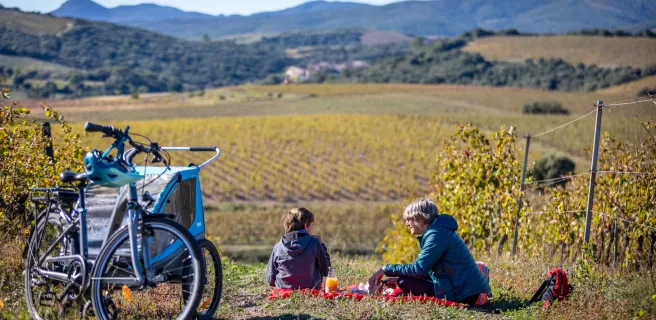
Bédarieux marks the end of the PassaPaïs Greenway. Mountainous landscapes give way to the gentler landscapes of the Avant-Monts area, vines stretching out as far as the eye can see. You may spot the sea on the horizon, a distant promise. For now, you’re entering a land rich in traditions and skills passed down the generations, while its vineyards are highly regarded today. The enchanting landscapes reflect the ingenious work carried out by farmers down the centuries, especially in the construction of dry-stone walls and capitelles (stone huts). Much older traces of civilization await a bit further on, of an ancient village inhabited first by the local Elisych tribe, then by Gauls, the oppidum of Ensérune, a pre-Roman hilltop settlement, and a star-shaped, now dried-out lake, the Etang de Montady. Moving on to the 17th century and the great engineer Pierre-Paul Riquet, his genius can be seen in the Tunnel du Malpas, dug under a hill to enable the Canal du Midi to pass through these parts, and in the monumental nine locks at Fonseranes beside Béziers. Final stop Béziers, to discover splendid bourgeois buildings reflecting flourishing commercial times and the splendid St Nazaire Cathedral, as well as following the city’s famed camel signs, indicating an historic trail and recalling the legend of a saint from Egypt, brought here thanks to the aid of his faithful animal to convert the people to Christianity.

Découvrez également