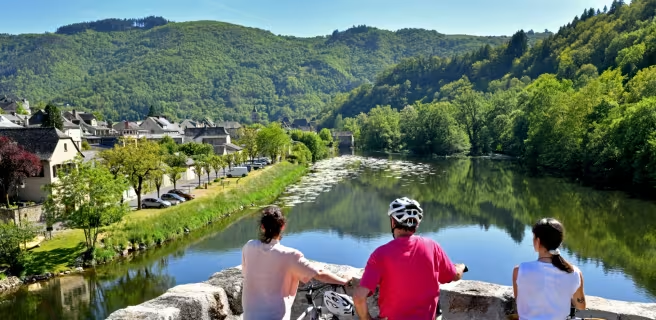


Between perched villages and villages at the foot of the Lot, discover a charming, authentic and rich heritage on the Lot Valley by bike.

The perched village of Albas
It’s worth the effort of climbing some 50 metres from the banks of the Lot to the rocky outcrop on which the higher parts of the village of Albas stand. This place was owned by the bishopric of Cahors, hence its exceptionally elegant buildings. Enjoy the splendid views over the Lot Valley and its vines. The port flourished when the river was a major trading route; now it’s used by pleasure boats and a few restored, old-fashioned vessels called gabares. Ascension Saturday sees the celebration of the Cahors Wine Festival here.

Castelmoron-sur-Lot and its castle
Nestled in a meander in the Lot Valley, the village of Castelmoron grew up around its castle as early as the 13th century. In the 16th century, the place became a major refuge for Protestant Calvinists. It conceals startling buildings, notably the Château Solar, in neo-Moorish style. Located on a wide terrace over the Lot, this now houses the town hall. Castelmoron has a much-loved port, plus a sandy beach near the campsite in the neighbouring parish of Le Temple-sur-Lot.

Le Temple-sur-Lot and its commander’s residence
Le Temple-sur-Lot is a lovely village, its site chosen back in the 13th century by the Knights Templar to build an impressive commander’s residence, which has been restored. The Lot River is very wide here and the village boasts a water sports centre, as well as attracting many waterfowl. Continuing on the watery theme, seek out the remarkable water lily garden, or Jardin des Nénuphars, the oldest aquatic plant nursery in the world, founded in the 19th century and still open to the public. This welcoming village offers many facilities and is on a greenway linking it with Sainte-Livrade.

Luzech and its dungeon, set right in a meander
Set in the heart of a tight meander in the Lot Valley, the homes in the medieval village of Luzech stand in the shadow of their protective historic bishops’ castle. At the narrowest point in the meander, the isthmus here is just 90 metres wide. Luzech’s rich heritage includes the Armand Viré Museum, retracing local history back to the palaeolithic. As well as pretty terraces over the Lot, the village offers nautical activities on the river. As to the powerful hydroelectric dam here, it provides the equivalent of all the electricity needed for the city of Cahors.

The charming bastide of Castelfranc
Its feet bathing in the Lot River and its tributary, Le Vert, the little 13th-century fortified bastide of Castelfranc has retained all its charm. Its central square is dominated by a remarkable 14th-century fortified church, with a typical regional flat bell-gable. Don’t miss the ravishing Jardin des Sens, which copies the pattern of a medieval medicinal herb garden. A bucolic greenway runs beside the Lot towards Albas, a village close by.

Puy L'Evêque and its hanging gardens
On the borders of the historic Périgord and Quercy regions, this former medieval stronghold is perched 30 metres above the Lot. It still looks formidable. From the bridge, spy on its historic port, once one of the most important along the river. Lose yourself in the maze of medieval streets, overseen by magnificent dwellings in golden stone, some built as bishops’ residences. With its terraces and restaurants over the river, the village makes an enticing stop on the Vallée du Lot à Vélo cycle route. You can go boating on the Lot here too.

Villeneuve-sur-Lot, city of character
Surrounded by orchard-covered hills, Villeneuve-sur-Lot is one of the oldest fortified grid-plan towns, or bastides, in southwest France. Built by the Lot River, it’s an attractive place. Discover central Lafayette Square, the Pujols and Paris towers, the theatre, Les Cieutat Bridge and its Notre-Dame-du-Bout-du-Pont Chapel, St Stephen’s Church and its rose garden, and St Catherine’s Church, with its startling belfry. The town makes a lovely stop on the Vallée du Lot à Vélo cycle route, offering plenty of accommodation and restaurants.

Clairac and its beach on the Lot
Close to where the Lot River joins the Garonne, Clairac became the seat of a Benedictine abbey many centuries ago. The medieval village that grew up alongside it stands 50 metres above the Lot. Its pretty streets are lined with timber-framed houses and grand homes, some now converted into restaurants and B&Bs. Museums allow you to understand Clairac’s rich history. At the foot of the village, discover the little beach beside the Lot, by the campsite.

Cahors, a medieval architectural landmark
Practically encircled by a perfectly shaped meander in the Lot River, Cahors is a city that has stood at a major crossroads for a very long time. Renowned for its wealth of medieval buildings, the town has many attractions, such as its riverbanks, the great Pont Valentré Bridge, the Soubirous Quarter, St Stephen’s Cathedral, private mansions, secret gardens, and fine markets and restaurants, all making it a memorable stopover on the Santiago pilgrimage trail as well as the Vallée du Lot à Vélo cycle route. Cahors tourist officeoffers many guided tours.