

From Bellegarde Fort to Sète
A taste of the Pyrenees is your appetizer before the first fine beaches of the Méditerranée à Vélo and a family-friendly portion of EuroVelo 8. Cycling between the resorts of Argelès-sur-Mer and Leucate, or Marseillan-Plage and Sète, the blue of the Med makes a magical companion. Combine the joys of the beach with a not too taxing daily distance of travel, making the most of what’s on offer along the way. For nautical activities, Leucate is the top destination. For nature discoveries, enjoy the Canal de la Robine and Canal du Midi. These are just a couple of ways of making the most of the Méditerranée à Vélo.

The Albères vineyards at St-Genis-des-Fontaines
As a prelude to setting off from Argelès-sur-Mer, with a view towards the Pic du Canigou, the region’s Catalan peak, the Albères massif forms the easternmost part of the Pyrenees mountain range. On these south-facing slopes lies a vineyard through the centre of which runs the Mediterranean Cycle Route – EuroVelo 8 – as it climbs towards the Col du Panissars and Spain. A hinterland where it is lovely to wander, discovering the abbey church and cloister of St-Genis-des-Fontaines.

Saltwater lagoons
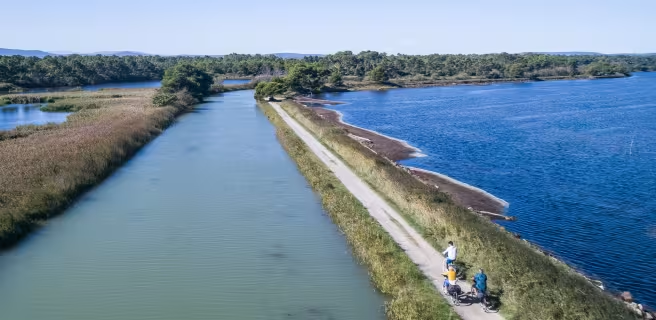
A characteristic feature of this coastline are the saltwater lagoons, including that of Salses-Leucate, where kitesurfers who love this windy spot can be seen in action. From Port La Nouvelle, the atmosphere changes with the island of Sainte-Lucie and the Canal de la Robine, which takes you gliding along an isthmus between land and water to reach Narbonne, the birthplace of the ‘singing madman’, Charles Trenet. There’s joy here!

The majestic city of Narbonne
In the heart of Narbonne stands the former Archbishop’s Palace, flanked by two square towers – a monumental Neo-Gothic complex comprising a cloister and the Cathedral of Saints Just and Pasteur. Today, this site houses the cathedral treasury and boasts a rich collection of archaeological remains and works of art. Other must-see sites include Charles Trenet’s house and the sumptuous market halls, home to a host of food shops; ideal for stocking up on local produce before setting off again by bike.

Engineering feats & the art of living
A showcase of hydraulic engineering, the Canal du Midi’s engineering structures are ingenious feats of engineering, built to stand the test of time:
On the outskirts of Agde, the round lock was built in 1680 to connect the Canal du Midi to the town of Agde. It serves as both a lock and a river junction with its three waterways. It remains the only round lock in France to this day. Originally 29 metres in diameter, it was enlarged in the 1970s to facilitate the passage of large boats.
Near Béziers, the nine locks of Fonseranes form a monumental staircase used by 10,000 boats a year. Designed by Paul Riquet, this major engineering structure on the Canal du Midi is listed as a UNESCO World Heritage Site.
When engineering structures serve the art of living, the hamlet of Le Somail is an architectural ensemble comprising remarkable buildings: an inn that has retained the same charm as in 1773, a chapel built between 1684 and 1693, and even an ice house that supplied the inn and the shops of Le Somail with ice during the hot summer days. At the heart of the village lies the Pont Saint-Marcel with its remarkable semi-circular shape.

360° view of Sète
A unique peninsula nestled between the Étang de Thau and the sea, the large port of Sète was opened 350 years ago to link the Mediterranean Sea to the Canal du Midi. To admire this port city, where Georges Brassens is buried, you must climb 183 metres to the Mont St-Clair viewpoint. There, you can enjoy a 360° panoramic view of the city’s grid of canals and take in the intertwining of the land and sea horizons.
Tailor-made itineraries
Tailor-made itineraries
Télécharger le GPX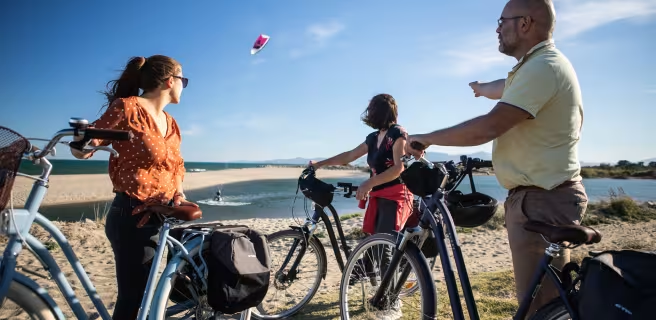
2 Argelès sur Mer / Leucate
3 Leucate / Narbonne
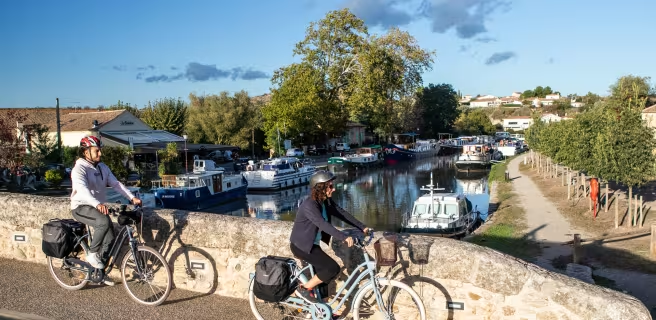
4 Narbonne / Béziers
It is advisable to request written authorization to cycle across these parts from VNF, the managing authority, in accordance with Article R4241-68 of the French Code des Transports.
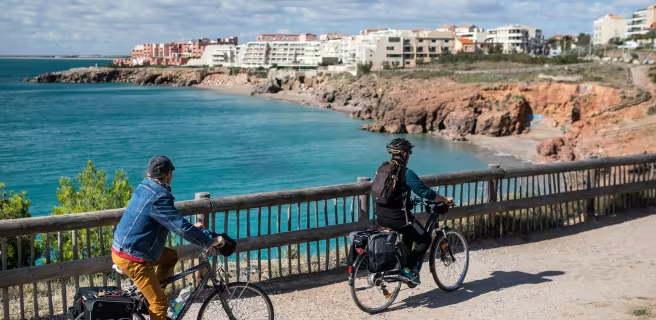
5 Béziers / Sète
It is advisable to request written authorization to cycle across these parts from VNF, the managing authority, in accordance with Article R4241-68 of the French Code des Transports.
See also